PURE RAW FINE BOTANICAL
RAW INGREDIENT
🛒 Buy 4 Save 20% – Mix & Match
Average UK Delivery Time: 1-3 Days
✈️ Free UK Delivery – Orders Over 25 GBP
📦 9.95 GBP Next Day Delivery (Orders before 12 noon)






Original price was: £9.99.£5.99Current price is: £5.99.
RAW INGREDIENT
🛒 Buy 4 Save 20% – Mix & Match
Average UK Delivery Time: 1-3 Days
✈️ Free UK Delivery – Orders Over 25 GBP
📦 9.95 GBP Next Day Delivery (Orders before 12 noon)
47 in stock
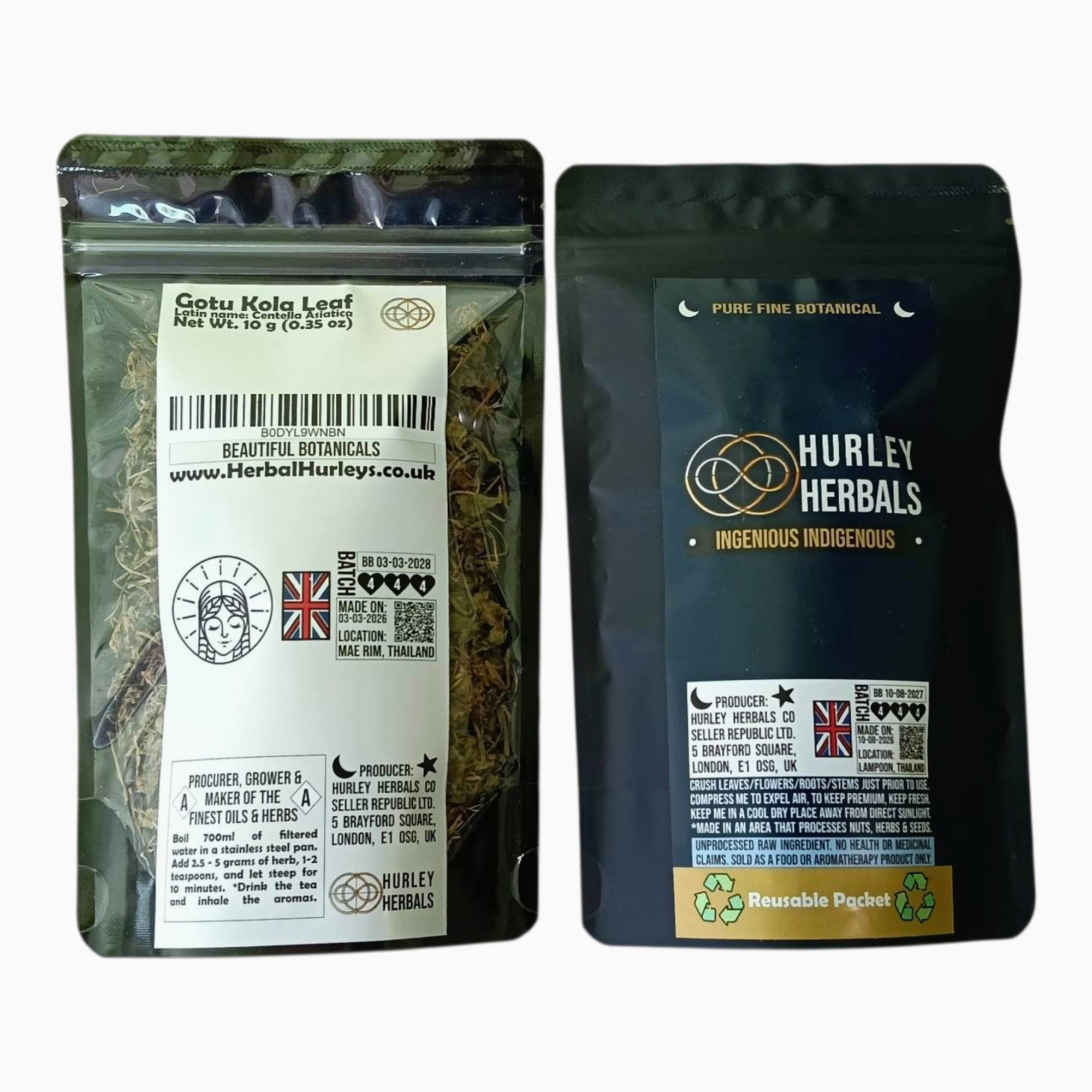
Gotu kola is the dried leaf of Centella asiatica, a low creeping plant of tropical wetlands and a member of the carrot family. Rounded, coin-shaped leaves on short stalks, from a plant that spreads flat across wet ground rather than growing upward.
We supply it as a raw botanical — whole dried leaf, cleaned and graded, nothing added.
A perennial herb in the Apiaceae family — the carrot and parsley family, alongside celery, fennel, coriander, dill and parsnip. It is one of the smallest plants in a family better known for tall hollow-stemmed umbellifers.
It reaches only 8 to 10cm in height but spreads indefinitely sideways along slender creeping stolons, green to reddish-green, which root at the nodes as they travel. A single plant becomes a mat rather than a clump.
That shape is the identifying feature and it is where most of the plant’s common names come from — coinwort, pennywort, Indian pennywort, spadeleaf.
The blade is rounded, fan-shaped to kidney-shaped, smooth-edged or shallowly scalloped, carried on a stalk about 2cm long that rises from the creeping stem. The venation is palmately netted, radiating from where the stalk meets the blade, which is visible when a dried leaf is held to the light.
Nothing else in the family looks like this. A carrot leaf is finely dissected; gotu kola is a plain rounded disc.
In the flowers, which almost nobody notices. They are minute — under 3mm — white or crimson, and carried in tiny rounded umbels held right down at soil level, often hidden beneath the leaves.
The umbel is the Apiaceae signature: the same structure as a carrot flower head or a head of dill, shrunk to a few millimetres and pressed against the ground. Once you know it is there, the family relationship stops being surprising.
By the fruit, and this is the distinction botanists use. Centella asiatica has densely reticulate fruit — netted, patterned. The Hydrocotyle pennyworts it is constantly confused with have smooth, ribbed or warty fruit instead.
The confusion has history behind it: Centella was once classified as Hydrocotyle asiatica, and the two genera are similar enough at leaf level that the names are still used interchangeably in trade.
For a buyer the practical version is simpler. Insist on the binomial. Material sold as “pennywort” with no Centella asiatica next to it might be a different genus entirely.
In wetlands, across a very wide range: tropical and subtropical Africa, Asia, Australia and the islands of the western Pacific. It favours swampy ground, pond and river margins, ditches and damp shaded places at moderate altitude.
It grows fast. The crop matures in about three months, and the plant spreads aggressively enough to be rated a high invasion risk in several Pacific island groups where it has been introduced. In cultivation that vigour is the point — a bed establishes quickly and can be cut repeatedly rather than replanted.
Cut rather than lifted. Because the plant is a stoloniferous perennial, harvesting the leaf leaves the running stems and root system in place, and the bed regrows. That is why gotu kola suits smallholder production and why it is available year-round rather than seasonally.
After cutting, leaf is separated from the stolon and stalk material, washed, dried and graded. Ours is naturally dried and vacuum sealed.
The separation step is where quality is made or lost. Stolon is stringy and adds weight without adding leaf, so material heavy in running stem is cheaper to produce and worth less.
| Look for | Good material | Poor material |
|---|---|---|
| Leaf shape | Rounded discs still recognisable | Uniform small fragments |
| Stalk and stolon | Minimal, mostly leaf | Visible stringy stem throughout |
| Colour | Green to olive | Khaki or straw — light-faded or old |
| Venation | Palmate netting visible against light | Not assessable |
| Foreign matter | None — it grows at ground level, so grit matters | Soil, grit, other plant material |
That last row is specific to this plant. Gotu kola grows flat on wet ground, so washing before drying is not optional, and grit in the pack is a processing failure rather than bad luck.
| Whole dried leaf (this) | Powder | |
|---|---|---|
| Identifiable by eye | Yes — leaf shape and venation visible | No |
| Stolon content | Visible and assessable | Unknowable once milled |
| Adulteration risk | Low — substitution shows | Higher — nothing shows |
| Surface area | Lower | Very high |
| Shelf behaviour | Holds colour longer | Fades and oxidises faster |
| Handling | Light, bulky, brittle | Dense, dusty, hygroscopic |
The argument for whole leaf is verification. You can see the species, see the grade and see the stem content. A powder is a matter of trust in whoever milled it.
Because it does not have to build anything tall. Every resource goes into running sideways: a stolon extends, roots at a node, and the new crown puts out its own stolons. There is no stem to support and no wood to make.
That strategy is why the crop matures in roughly three months and why the plant is rated a high invasion risk on several Pacific island groups. It occupies wet open ground faster than anything competing with it, and once established a mat is difficult to break up because every rooted node is effectively a separate plant.
Commercially it is an advantage. A bed cut for leaf regrows from an intact network rather than being replanted, so the same ground yields repeatedly.
Green to olive discs, thin and light, often curled at the edge where they dried. Held to the light the palmate venation shows as a net radiating from the point where the stalk met the blade.
The material is bulky for its weight. Fifteen grams of whole gotu kola leaf occupies noticeably more volume than fifteen grams of a thicker or denser leaf, which is normal and not a sign of underfilling.
| Botanical name | Centella asiatica |
| Also known as | Gotu kola, Indian pennywort, coinwort, spadeleaf, brahmi |
| Former name | Hydrocotyle asiatica |
| Family | Apiaceae (carrot family) |
| Part used | Leaf |
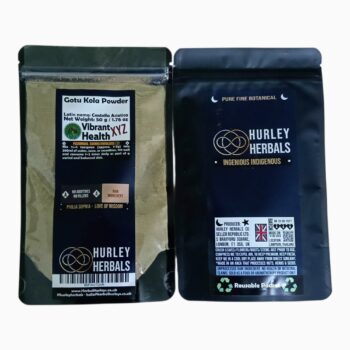
| Form | Whole dried leaf |
| Plant habit | Creeping perennial, 8–10cm tall, stoloniferous |
| Origin | Thailand |
| Processing | Washed, naturally dried, graded, vacuum sealed |
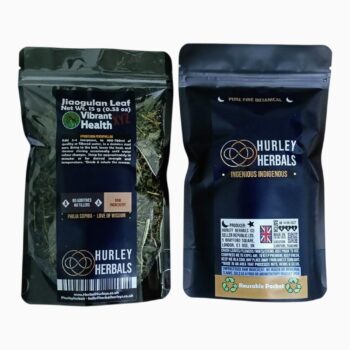
| Net weight | 15g |
| Ingredients | Gotu kola leaf. Nothing added. |
| Supplied as | Raw botanical material |
| On pack | Batch ID, picked date, best before date |
| Packaging | Vacuum sealed, reusable |
Less than you would think. The species epithet says the plant was described from Asia, not that it is confined there — Centella asiatica is genuinely pantropical, growing wild across Africa, Asia, Australia and the Pacific.
Centella itself is a diminutive from the Latin centum, a hundred, and the genus contains a large number of species, most of them African. The Asian one is simply the species that travelled into commerce.
Not necessarily, and this is a genuine naming trap. In India the name brahmi is applied both to Centella asiatica and to Bacopa monnieri — two unrelated plants in different families that look nothing like each other.
Bacopa monnieri is in the Plantaginaceae, with small succulent oblong leaves and pale flowers, growing in shallow water. Centella is the coin-leaved carrot relative on this page.
Anything sold as brahmi without a binomial could be either. Same problem as pennywort, different direction.
Between them, gotu kola carries three separate naming collisions — with Hydrocotyle, with Bacopa, and with the unrelated kola nut, which shares nothing but a syllable. Few botanicals in ordinary trade are as easy to mis-sell by name alone, and it is the single strongest argument for buying whole leaf with a binomial attached.
Set out as record rather than recommendation.
Gotu kola is documented as a leaf vegetable across South and Southeast Asia — Sri Lanka, southern India, Thailand, Vietnam and Indonesia — where fresh leaf is used in salads and soups. The Sri Lankan preparation gotu kola sambola, in which the fresh leaf is shredded very fine with coconut and lime, is the best-documented example.
It appears in classical Ayurvedic and traditional Chinese materia medica, and it is grown commercially in several Asian countries today. That is the documented record. We make no claims arising from it.
This is a raw botanical. It is supplied as whole dried leaf, and no preparation instructions are given on this page.
Because it is not supplied as a food, no allergen declaration or nutrition information is provided — those requirements attach to food, and this is raw material.
Cool, dry, dark and airtight. Best before: see base of package. The leaf is thin and holds its shape well but is brittle when fully dry, so a rigid container preserves the leaf discs that make the material identifiable. Daylight fades green to khaki over months.
Is gotu kola related to carrots?
Yes. It is in the Apiaceae family alongside carrot, celery, fennel, coriander and dill. The tiny umbel flowers held at soil level are the family signature.
Why is it called pennywort?
For the leaves, which are rounded like small coins. The same shape gives coinwort, spadeleaf and Indian pennywort.
How is it different from Hydrocotyle pennywort?
By the fruit. Centella asiatica has densely netted fruit; Hydrocotyle species have smooth, ribbed or warty fruit. They look similar at leaf level, which is why Centella was once classified as Hydrocotyle asiatica. Buy on the binomial.
Is brahmi the same as gotu kola?
Sometimes. In India the name brahmi is used for both Centella asiatica and Bacopa monnieri, which are unrelated plants in different families. Anything sold as brahmi without a binomial could be either.
Where does it grow?
Wetlands across tropical and subtropical Africa, Asia, Australia and the western Pacific — swampy ground, pond and river margins and damp shaded places. The crop matures in about three months.
How do I judge the grade?
Look for recognisable rounded leaf discs, minimal stringy stolon, green rather than khaki colour, and no grit. It grows flat on wet ground, so washing before drying is essential and grit is a processing failure.
Why choose whole leaf over powder?
Verification. With whole leaf you can see the species, the grade and the stem content. Once milled, none of that is assessable.
Why is there no allergen or nutrition information?
Because those requirements attach to food. This product is supplied as raw botanical material.
We value the rich heritage of herbal traditions that spans centuries. Our interest in herbs is informed by both historical practices and modern understanding of botanicals.
We source our ingredients from carefully selected suppliers who follow sustainable harvesting and cultivation practices. Our production methods are designed to preserve the natural qualities of our botanicals through vacuum sealing and gentle processing techniques.
Our packaging is designed to be reused. Simply wash thoroughly after use.
Stocks are rotated annually. Please note packaging may vary as we update our product range.
Last updated: 8 September 2026.
Botanical data cross-checked against Wikipedia’s Centella asiatica entry, NC State Extension, CABI and published Apiaceae floras.
Raw botanical material. Packaging may vary. No health claims made. Information on this website is for educational purposes only and is not intended as medical advice.
| Weight | 10 g |
|---|---|
| Dimensions | 15 × 2.5 × 22 cm |
| Colour | n/a |
| Herbal Extraction | n/a |
| Country of origin | Thailand |
| Ean | 680699850195 |
| Flavour | Aluminium Ziplock |
| Indigenous herbal use | Good Health |
| Indigenous stone use | n/a |
| Ingredients | Dried Gotu Kola Leaves (Centella Asiatica) |
| Metal | n/a |
| Semi precious stone | n/a |
| Tribe | n/a |
| Wild essential oil | n/a |
| Weight |
Only logged in customers who have purchased this product may leave a review.


Mally –
Very good quality
Beth –
Bought before, will be buying again
Christie –
Will be buying again
Jay –
Very professional products and service. Quick delivery
Angus –
Excellent shop, great service, thank you