RAW INGREDIENT
🛒 Buy 4 Save 20% – Mix & Match
Average UK Delivery Time: 1-3 Days
✈️ Free UK Delivery – Orders Over 25 GBP
📦 9.95 GBP Next Day Delivery (Orders before 12 noon)

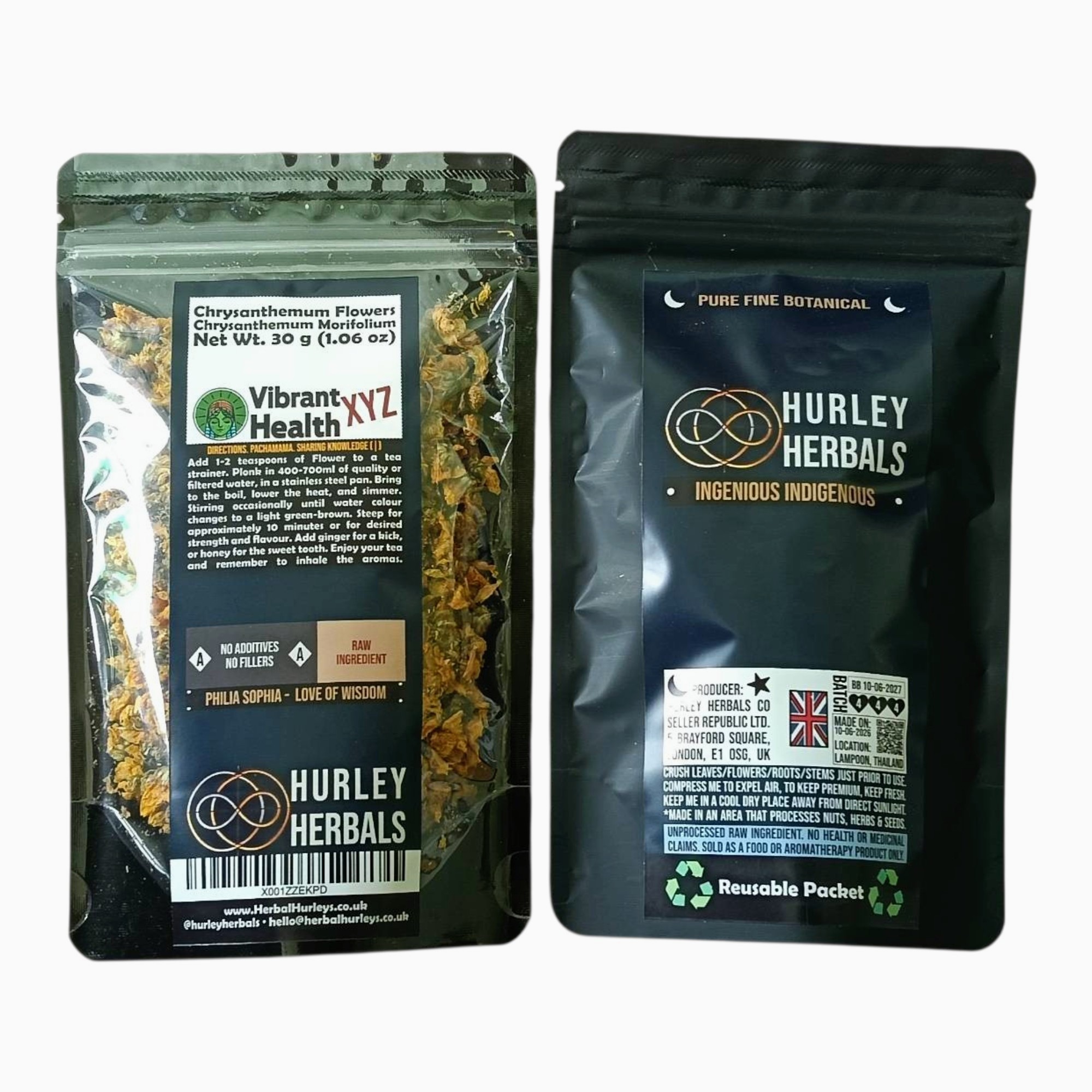


Original price was: £9.99.£6.34Current price is: £6.34.
RAW INGREDIENT
🛒 Buy 4 Save 20% – Mix & Match
Average UK Delivery Time: 1-3 Days
✈️ Free UK Delivery – Orders Over 25 GBP
📦 9.95 GBP Next Day Delivery (Orders before 12 noon)
116 in stock (can be backordered)
Chrysanthemum tea is the dried flower head of Chrysanthemum morifolium, known in China as juhua. The whole flowers open again in the cup — drop them into hot water and they unfurl, which is half the reason people drink it.
Light, honeyed and faintly floral, with no tannin and no bitterness when brewed properly. It is the tea you serve alongside something rich, and the one that works best iced.
A perennial herb in the Asteraceae family — the daisy family, alongside sunflowers, lettuce and artichokes. It grows 60 to 100cm tall on erect, slightly branched stems with a rough surface and alternate oval leaves.
What you buy is the capitulum: the flower head. In daisies that is not one flower but a dense composite of many tiny individual florets packed onto a common base. Every chrysanthemum head is a crowd.
Old enough that the dates are argued over. The plant has been cultivated in China for more than 3,000 years, and its use as a flower tea is generally traced to the Han dynasty, roughly 2,000 years ago.
The first monograph devoted to chrysanthemums appeared in 1104 AD. It reached Japan in the 12th century and Europe only in the late 1700s, when a French navigator carried plants back from China and the botanist Ramatuelle described them in 1792 — which is why the species still carries his naming.
In Chinese culture the chrysanthemum is one of the Four Gentlemen, alongside plum blossom, orchid and bamboo, and it stands for autumn.
Because the tea cultivars generally cannot be. Chrysanthemum morifolium is an ancient cultigen of hybrid origin — it is often written Chrysanthemum × morifolium for exactly that reason — and the traditional tea varieties are propagated by division and cuttings rather than seed.
The result is a staggering amount of variation. Estimates put the number of chrysanthemum cultivars worldwide somewhere between 20,000 and 30,000, with over 3,000 in China alone. Tea cultivars are a small, specific subset selected over centuries for flavour rather than for the flower show.
Yes. Chinese tea chrysanthemums split broadly into white types and yellow types, and they do not taste the same.
Yellow flowers, tend to be more aromatic and carry a fuller, slightly sweeter body with a touch more depth. White types generally brew paler and more delicate. Neither is better — but if you have had chrysanthemum tea before and found it thin, it was probably white.
| Botanical name | Chrysanthemum morifolium |
| Also known as | Juhua, florist’s daisy, hardy garden mum |
| Family | Asteraceae (daisy family) |
| Part used | Whole dried flower heads |
| Flower type | See pack — Chinese tea chrysanthemum |
| Origin | Thailand |
| Cultivation | Small local farms, traditional methods |
| Processing | Naturally dried whole, heads intact |
| Net weight | 30g |
| Aroma | Honeyed, floral, gently sweet |
| Ingredients | Pure loose flower tea. Chrysanthemum only. |
| On pack | Batch ID, picked date, best before date |
| Packed by | Seller Republic Limited (Vibrant Health XYZ), UK — general food business product or raw material |
| Packaging | Vacuum sealed, reusable |
Tea House method, as supplied: add 1–2 tablespoons of herbs to 1 litre of water in a stainless steel pan. Bring to a boil and simmer for 5–10 minutes according to taste preference. The colour will deepen as it steeps. The herbs may be reused 2–4 times over the following 2 days, with flavour varying between brews.
4 to 6 whole flowers per 250ml. Boil the water, then let it stand for a minute to fall to around 90–95°C before pouring. Steep 2 to 3 minutes for the first infusion.
Use a glass rather than a mug. Chrysanthemum is one of the few infusions where watching it happen is part of it — the tight dried heads swell and open, the petals lift, and the water turns pale gold.
Water straight off a rolling boil scalds the petals and pulls a grassy edge that is not there otherwise. Ninety-odd degrees is the difference between honeyed and green.
Chrysanthemum resteeps well — better than most flowers. Three or four infusions from the same heads is normal, each one lighter than the last. Add 30 seconds to each successive steep.
Brew 8 flowers in 250ml, steep 4 minutes, then pour over a full glass of ice. Chrysanthemum is arguably better cold than hot, and it is the base of the bottled chrysanthemum drinks sold across East and Southeast Asia.
| Yellow types | White | |
|---|---|---|
| Aroma | Fuller, more pronounced | Lighter, more delicate |
| Body | Slightly sweeter, more depth | Thinner, cleaner |
| Brew colour | Deeper gold | Pale straw |
| Flower size | Generally smaller heads | Often larger heads |
| Best for | Drinking alone, iced, blending under bitter herbs | Very light drinking, delicate blends |
| If you found chrysanthemum thin before | Try a yellow type | This was probably it |
Neither is better. But if your only previous experience of chrysanthemum tea was a pale, watery cup, it was almost certainly a white type brewed short. Yellow gives you something to hold on to.
Across China and Southeast Asia, chrysanthemum turns up beside dim sum, hotpot and grilled meat rather than on its own at breakfast. There is a straightforward reason: it has no tannin and no bitterness, so it does not compete with what you are eating, and it is served warm rather than scalding, which resets the palate between mouthfuls.
It is also the standard partner for anything bitter. That is why the traditional pairing is with goji berries, and why it works so well over papaya leaf — floral sweetness against a hard edge is a combination Chinese tea culture has been using for centuries.
It is a natural partner rather than a soloist, and it is the classic Chinese pairing for anything bitter.
Because it is not one flower. What looks like a single bloom is a capitulum — the daisy-family arrangement in which dozens or hundreds of tiny individual florets are packed onto a shared base, presenting themselves collectively as if they were one large flower.
Every “petal” on a chrysanthemum head is a complete floret with its own parts. When the dried head unfurls in hot water, what you are watching is a whole colony of flowers rehydrating at once, not one flower opening.
That structure is also why the head survives drying so well. Individual florets are small and low in water, so they dry fast without collapsing, and the shared base holds them together into something you can pick up with a spoon.
Not the ones in a florist’s window. Tea chrysanthemums are a small, specific subset of the 20,000 to 30,000 cultivars that exist worldwide, selected over centuries for flavour rather than for size or show.
China grows several named types for the purpose — Hangbaiju and Gongju are among the best known, with Huangshan gongju grown in the mountains of Anhui. Those traditional tea varieties are propagated by division and cuttings rather than from seed, which keeps each type consistent from one generation to the next.
A garden chrysanthemum is a different plant bred for a different job. Bigger heads, stronger colour, no attention paid to how it tastes.
Ingredients: Chrysanthemum flowers (Chrysanthemum morifolium). Single ingredient. Nothing added.
Allergens: This product contains none of the 14 allergens that must be declared under UK law — celery, cereals containing gluten, crustaceans, eggs, fish, lupin, milk, molluscs, mustard, peanuts, sesame, soybeans, sulphur dioxide and sulphites, and tree nuts.
One note that is not a regulated allergen but is worth stating plainly: chrysanthemum is a member of the Asteraceae family, along with ragweed, daisies and marigolds. People who react to other plants in that family sometimes prefer to avoid it.
We publish this before you buy because we have to. Under Article 14 of assimilated Regulation (EU) 1169/2011, food sold at a distance must carry the same mandatory information as food bought in a shop, available free of charge before the purchase is concluded and again at delivery.
Nutrition declaration: Not required for this product. Annex V of assimilated Regulation (EU) 1169/2011 exempts all forms of tea and herbal infusions containing no added ingredients that would change nutritional value.
We value the rich heritage of herbal traditions that spans centuries. Our interest in herbs is informed by both historical practices and modern understanding of botanicals.
We source our ingredients from carefully selected suppliers who follow sustainable harvesting and cultivation practices. Our production methods are designed to preserve the natural qualities of our herbs through vacuum sealing and gentle processing techniques that maintain freshness and flavour integrity.
Our packaging is designed to be reused. Simply wash thoroughly after use.
Herb stocks are rotated annually to ensure freshness. Please note packaging may vary as we update our product range.
Store in a cool, dry place away from direct sunlight. Best before: see base of package. Keep the container reasonably rigid — whole flower heads crush easily, and crushed heads brew cloudier and open less impressively. Light fades petal colour, so dark storage keeps them looking as good as they taste.
How many flowers per cup?
Four to six whole heads per 250ml. Eight if you are brewing for ice.
What temperature should the water be?
Around 90 to 95°C. Boil the kettle and let it stand a minute. Water straight off the boil scalds the petals and turns it grassy.
How long do you steep it?
Two to three minutes for the first infusion, adding 30 seconds for each resteep. Three or four infusions from the same flowers is normal.
Do the flowers really open up?
Yes. The dried heads swell and unfurl in hot water. Brew it in glass and you can watch it.
What is the difference between yellow and white chrysanthemum tea?
Yellow types tend to be more aromatic with a fuller, slightly sweeter body. White types brew paler and more delicate. Check the pack for which type you have.
Why is it called juhua?
That is the Chinese name for the flower head, and the name the tea is sold under across China.
Does it contain allergens?
No. None of the 14 allergens that must be declared under UK law. Note that it is an Asteraceae plant, the same family as ragweed and daisies.
How long does it keep?
Each pack carries a best before date on the base, alongside the batch ID and picked date. Store cool, dry, dark and protected from crushing.
Last updated: 8 September 2026.
Botanical and historical data cross-checked against peer-reviewed reviews of Chrysanthemum morifolium, horticultural records and published cultivation histories.
Raw ingredient. Packaging may vary. All herbs are marked with Batch ID, Picked Date and Best Before Date. No health claims made. Information on this website is for educational purposes only and is not intended as medical advice.
| Colour | n/a |
|---|---|
| Herbal Extraction | n/a |
| Country of origin | Thailand |
| Flavour | Chrysanthemum Flowers |
| Indigenous herbal use | Good Health |
| Indigenous stone use | n/a |
| Ingredients | Dried Chrysanthemum Flowers (Chrysanthemum Species) |
| Metal | n/a |
| Semi precious stone | n/a |
| Tribe | n/a |
| Wild essential oil | n/a |
| Weight |
Only logged in customers who have purchased this product may leave a review.



April –
Absolutely loved this
Jonnf F. –
Best quality seen in a while
Anne.B –
Divine
Freddy –
Top products