PURE RAW FINE BOTANICAL
RAW INGREDIENT
🛒 Buy 4 Save 20% – Mix & Match
Average UK Delivery Time: 1-3 Days
✈️ Free UK Delivery – Orders Over 25 GBP
📦 9.95 GBP Next Day Delivery (Orders before 12 noon)



Original price was: £9.99.£5.99Current price is: £5.99.
RAW INGREDIENT
🛒 Buy 4 Save 20% – Mix & Match
Average UK Delivery Time: 1-3 Days
✈️ Free UK Delivery – Orders Over 25 GBP
📦 9.95 GBP Next Day Delivery (Orders before 12 noon)
7 in stock
Zarzaparrilla is the dried root and rhizome of Smilax aspera, a thorny evergreen climber of the Mediterranean. Supplied as a raw botanical.
The name carries a trap, and it is the first thing this page deals with. Sarsaparilla is not one plant. It is a name applied across a genus of three hundred-odd species on four continents, and the species matters.
Smilax aspera — the Mediterranean one. It goes by rough bindweed, common smilax, sarsaparille and European sarsaparilla, and zarzaparrilla is the Spanish name it has carried for centuries in its own range.
It is not Smilax ornata, the neotropical species behind root beer, old tonics and most of what the English-speaking world means by sarsaparilla. Nor is it S. regelii, S. aristolochiifolia or S. officinalis, the other American species sold under the same name.
Reference sources are explicit that although these plants are related, they are not chemically or therapeutically identical. Anything sold as sarsaparilla without a binomial could be any of them.
| Smilax aspera (this) | Smilax ornata | |
|---|---|---|
| Common name | Rough bindweed, European sarsaparilla, zarzaparrilla | Jamaican sarsaparilla |
| Native to | Mediterranean, southern Europe, western Asia, parts of Africa | Neotropics — Central America and the Caribbean |
| Habit | Evergreen thorny climber, 1–4m | Climbing vine |
| Best known for | Mediterranean scrub and hedgerow | Root beer and nineteenth-century tonics |
| Chemistry | Related but not identical. Different species, different profiles. | |
A perennial evergreen climbing subshrub in the Smilacaceae family, in the order Liliales. The climbing stem runs 1 to 4 metres, flexible and armed with sharp thorns.
The leaves are 8 to 10cm, alternate, tough and leathery, glossy, heart-shaped, sometimes marked with white spots, and with toothed and spiny margins. The midrib on the underside carries spines too, which is unusual and diagnostic — the plant is prickly on surfaces most climbers leave smooth.
It climbs by simple tendrils rather than twining.
Because monocots are supposed to have parallel veins. Grasses, lilies, orchids, palms — the veins run lengthwise without a network.
Smilax aspera is a monocot with reticulate venation: a net, like a broadleaf tree. It is one of the classic exceptions in botany teaching, and it is why the leaf does not look like it belongs to a lily relative at all.
That single feature, together with the spiny leaf margins, makes the plant straightforward to identify in the field despite belonging to a genus with hundreds of members.
The flowers are small, yellowish or greenish, gathered in axillary racemes, and very fragrant — considerably more so than their size suggests. In the Mediterranean they open late, from around September into November, which is unusual timing.
The fruit follows in autumn: globose berries in clusters, red at first and turning black as they ripen. They are conspicuous against the dark evergreen foliage and are taken by birds, which is how the plant moves.
Around the Mediterranean basin, extending into southern Europe, western Asia and parts of Africa. It is a plant of warm, dry habitats — hedgerows, woodland edges and Mediterranean scrub — growing up to around 800 metres.
It scrambles through other vegetation rather than standing alone, which is why it is more often felt than seen. Anyone who has walked through Mediterranean maquis has met it.
The derivation is genuinely uncertain and the candidates are worth knowing. Flora of North America lists three: an ancient Greek name for holm oak or for yew; a nymph in Greek myth who was turned into a bindweed; or smile, a scraper — a reference to the prickly stem, and specifically to Smilax aspera itself.
Aspera is not in doubt. It is Latin for rough, and it describes the plant accurately.
One further detail: Smilax aspera is the type species of the genus. It is the plant against which every other Smilax is defined — some three hundred to three hundred and fifty species across the tropics and subtropics.
The root and rhizome, which is the part used across the genus. It is the underground portion of a climbing plant, not a taproot, and it comes up as irregular knotted lengths rather than clean cylinders.
That shape matters when judging material. Root material is harder to identify by eye than leaf, because roots of unrelated species look broadly alike once dried and cut. There is no venation to check and no leaf shape to compare.
What you can assess is colour, density, smell on breaking, and whether the pieces are consistent with each other. What you cannot assess is species, which is why root is the form where the binomial matters most.
| Check | Good | Poor |
|---|---|---|
| Cut | Consistent lengths, cleanly cut | Mixed sizes, crushed or shattered ends |
| Colour | Even, characteristic of one batch | Mixed shades — suggests blended sources |
| Soil | None — root must be washed before drying | Grit, adhering soil, dark deposits in crevices |
| Density | Hard, snaps rather than bends | Soft or flexible — not fully dried |
| Smell on breaking | Present and characteristic | Musty, or nothing at all |
The soil point is not fastidiousness. Root is dug, and anything not washed off before drying is in the pack permanently. Unlike leaf, you cannot rinse it out afterwards without also extracting the material.
| Dried root (this) | Dried leaf | Root powder | |
|---|---|---|---|
| Species verifiable by eye | No | Yes | No |
| Density | Hard, woody | Light, bulky | Dense, fine |
| Shelf stability | High — little to oxidise | Moderate | Lower — high surface area |
| Adulteration risk | Moderate | Low | High |
| What you rely on | Supplier and binomial | Your own eyes | Supplier alone |
Our SKU carries the word wild, and it deserves defining rather than leaving as atmosphere.
Smilax aspera is not a plantation crop. It grows through Mediterranean scrub, hedgerow and woodland edge as a component of existing vegetation rather than in rows, and material entering trade is generally gathered from established stands rather than sown and cultivated.
That has two consequences worth stating. Batch-to-batch variation is greater than for a cultivated crop, because the plants are not clones grown in uniform conditions. And provenance depends on the collector, since there is no field to inspect.
Three reasons, and they compound.
You cannot identify it. Dried cut root of unrelated species looks broadly similar. There is no venation, no leaf shape, no flower.
The name is shared. Sarsaparilla covers several species across continents, so even an honest label may not mean what a buyer assumes.
It is dug, not cut. Everything the root grew in comes up with it, and anything not washed off before drying is in the pack for good.
None of that is a reason to avoid root. It is a reason to buy it on the binomial and on the supplier rather than on the common name.
| Botanical name | Smilax aspera |
| Also known as | Zarzaparrilla, rough bindweed, common smilax, sarsaparille, Mediterranean smilax |
| Not to be confused with | Smilax ornata, Jamaican sarsaparilla |
| Family | Smilacaceae, order Liliales |
| Taxonomic note | Type species of the genus Smilax |
| Part used | Root and rhizome |
| Form | Dried, cut |
| Native range | Mediterranean basin, southern Europe, western Asia, parts of Africa |
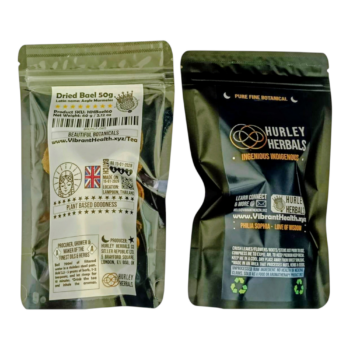
| Net weight | 30g |
| Ingredients | Zarzaparrilla root. Nothing added. |
| Supplied as | Raw botanical material |
| On pack | Batch ID, picked date, best before date |
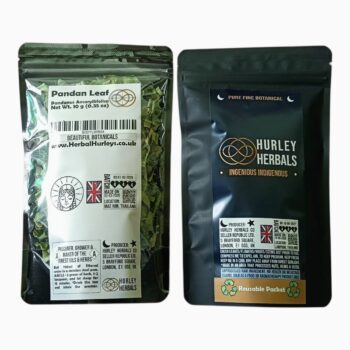
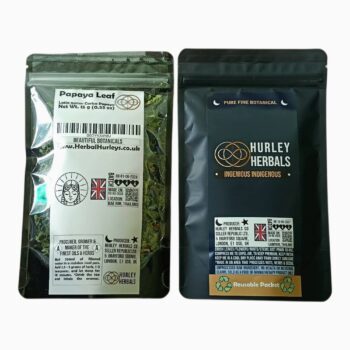
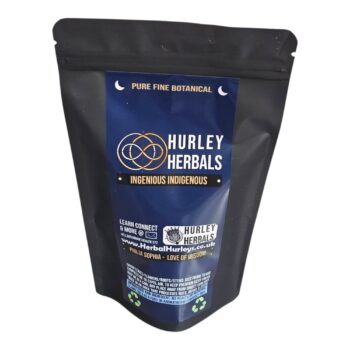
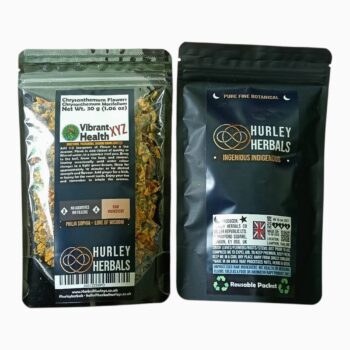
| Packaging | Vacuum sealed, reusable |
By seed from the berries, or by division of the rhizome. As a perennial climber it establishes slowly compared with a leaf crop, and the useful part is underground, so harvesting is destructive in a way that cutting leaf is not.
That difference is worth understanding when comparing root material to leaf material of any species. A leaf crop is cut and regrows; a root crop is lifted, and the plant does not.
Recorded rather than recommended, and the record here is largely one of confusion.
Sarsaparilla entered European commerce in the sixteenth century from the Americas, and the name attached itself afterwards to whatever local Smilax was to hand — hence European sarsaparilla for a Mediterranean plant that had been growing in Spanish and Italian scrub all along.
The genus is used across its range under a shelf of overlapping names: sarsaparilla, zarzaparrilla, China root, Jamaican, Honduran and Mexican sarsaparilla, and tu fu ling in Chinese practice for S. glabra. Different species, different continents, one name.
That is the documented record, and we make no claims arising from it.
This is a raw botanical. It is supplied as dried cut root and rhizome, and no preparation instructions are given on this page.
Because it is not supplied as a food, no allergen declaration or nutrition information is provided — those requirements attach to food, and this is raw material.
Cool, dry, dark and airtight. Best before: see base of package. Dried root is stable and undemanding compared with leaf — there is little volatile material to lose and no chlorophyll to bleach. The failure mode is damp: root that softens or bends rather than snapping has taken on moisture and should not be kept.
Is this the sarsaparilla in root beer?
No. That is Smilax ornata and related neotropical species. This is Smilax aspera, the Mediterranean plant. Sources state that although related, these species are not chemically identical.
Why do so many plants share the name?
Because sarsaparilla is a trade name applied across a genus of 300 to 350 species on several continents. China root, Jamaican, Honduran and Mexican sarsaparilla and tu fu ling are all different Smilax species.
What does aspera mean?
Latin for rough, describing the thorny stem and the spiny leaf margins. Smilax itself may derive from smile, a scraper, with reference to this very species.
Why is the leaf net-veined?
It is a genuine botanical oddity. Smilax is a monocot, and monocots normally have parallel venation. This genus has reticulate, net-like venation instead, which is one of the standard exceptions taught in plant identification.
Where does it grow?
Around the Mediterranean basin and into southern Europe, western Asia and parts of Africa, in hedgerows, woodland edges and Mediterranean scrub up to about 800 metres.
How do I judge dried root?
Consistent cut and colour, no soil or grit, hard enough to snap rather than bend, and a characteristic smell on breaking. Species cannot be judged by eye in root form, which is why the binomial matters more here than for leaf.
What part is in the pack?
Root and rhizome — the underground portion of a climbing plant, cut and dried. Irregular knotted lengths rather than clean cylinders.
Why is there no allergen or nutrition information?
Because those requirements attach to food. This product is supplied as raw botanical material.
We value the rich heritage of herbal traditions that spans centuries. Our interest in herbs is informed by both historical practices and modern understanding of botanicals.
We source our ingredients from carefully selected suppliers who follow sustainable harvesting and cultivation practices. Our production methods are designed to preserve the natural qualities of our botanicals through vacuum sealing and gentle processing techniques.
Our packaging is designed to be reused. Simply wash thoroughly after use.
Stocks are rotated annually. Please note packaging may vary as we update our product range.
Last updated: 8 September 2026.
Botanical data cross-checked against the Flora of North America, iNaturalist, published Mediterranean floras and horticultural records for Smilax aspera.
Raw botanical material. Packaging may vary. No health claims made. Information on this website is for educational purposes only and is not intended as medical advice.
| Weight | 20 g |
|---|---|
| Dimensions | 15 × 2.5 × 22 cm |
| Colour | n/a |
| Herbal Extraction | n/a |
| Country of origin | Colombia |
| Ean | 731199450986 |
| Flavour | Zarzaparrilla |
| Indigenous herbal use | Good Health |
| Indigenous stone use | n/a |
| Ingredients | Wild Harvested Zarzaparrilla Root (Smilax Species, Wild Sarsaparilla) |
| Metal | n/a |
| Semi precious stone | n/a |
| Tribe | n/a |
| Wild essential oil | n/a |
| Weight |
Only logged in customers who have purchased this product may leave a review.



There are no reviews yet.