RAW INGREDIENT
🛒 Buy 4 Save 20% – Mix & Match
Average UK Delivery Time: 1-3 Days
✈️ Free UK Delivery – Orders Over 25 GBP
📦 9.95 GBP Next Day Delivery (Orders before 12 noon)


Original price was: £9.99.£5.99Current price is: £5.99.
RAW INGREDIENT
🛒 Buy 4 Save 20% – Mix & Match
Average UK Delivery Time: 1-3 Days
✈️ Free UK Delivery – Orders Over 25 GBP
📦 9.95 GBP Next Day Delivery (Orders before 12 noon)
23 in stock
Stevia leaf is the dried leaf of Stevia rebaudiana, a small shrub from Paraguay whose leaves are sweet without any sugar in them. This is the whole leaf as it grows, not the white powder — a different product with a different taste and a different job.
The Guaraní have used it for more than 1,500 years, chiefly to sweeten yerba mate and other bitter drinks. That is still what it does best: a pinch in something else, rather than a cup of its own.
A tender perennial herb in the Asteraceae family — the daisy and sunflower family, alongside lettuce, chrysanthemum and safflower. It is small and plain: 30 to 60cm on weak, floppy stems, with small white flowers. The Missouri Botanical Garden notes drily that the plants have little ornamental attraction.
The genus Stevia is large, somewhere between 154 and 240 species depending on the authority. Only this one is grown for sweetness at any scale, and it is the leaves rather than any other part that carry it.
Northeastern Paraguay and adjacent southern Brazil, in subtropical conditions. The Guaraní name for it is ka’a he’ê — sweet herb — and they have used it for over 1,500 years.
Commercial cultivation is startlingly recent for a plant that old in use. The first commercial crop was reported in Paraguay in 1964; serious cultivation in Japan followed from 1971. It now grows across Asia, Europe and the Americas, and it adapts to a wide range of climates.
Steviol glycosides — a family of about ten related diterpene compounds including stevioside, rebaudioside A and dulcoside A. Between them they make up roughly 10 to 20% of the dry leaf.
By weight the sweetness is extraordinary: steviol glycosides are commonly put at 200 to 300 times the sweetness of sucrose, with individual compounds ranging from 30 to 450 times depending on which one and how it is measured. None is metabolised for energy.
They do not all taste the same, and this matters. Stevioside is the most abundant and carries most of the liquorice-like aftertaste. Rebaudioside A is cleaner. Refined sweeteners are made by isolating the cleaner compounds. A whole leaf gives you all of them at once, which is the honest difference between this and a sachet.
| Whole dried leaf (this) | Refined extract | |
|---|---|---|
| What it is | The leaf, dried | Isolated steviol glycosides |
| In the cup | Green-gold, and it tints | Invisible |
| Flavour besides sweet | Green, herbal, liquorice edge | Little to none |
| Aftertaste | Present, from stevioside | Reduced by selecting cleaner compounds |
| Best for | Sweetening an infusion from within | Baking, cold drinks, anywhere colour matters |
| Processing | Dried. Nothing else. | Extracted and purified |
| Carries an E number? | No | Yes — E960a |
Neither replaces the other. If you want an invisible sweetener, buy the extract. If you want to sweeten a herbal infusion with a leaf while it brews, this is the product — and it is what the Guaraní were doing with yerba mate long before anyone isolated anything.
Start with far less than feels sensible. A quarter teaspoon will sweeten a whole pot. Over-dosing is the single most common mistake and it produces a cup that is cloying and bitter at the same time.
¼ to ½ teaspoon added to a teaspoon of another herb, brewed together. This is the traditional use and the one it does best.
Add 1–2 tablespoons of herbs to 1 litre of water in a stainless steel pan. Bring to a boil and simmer for 5–10 minutes according to taste preference. For stevia specifically, use the lower end and taste early.
Yes, and it is the cleanest method. ½ teaspoon in 500ml of cold water with another herb, overnight in the fridge. Cold water pulls the sweetness and less of the green, herbal note.
1 teaspoon steeped in 250ml of hot water for 15 minutes, then strained, gives a sweet liquid you can add to anything by the spoonful. Refrigerate and use within a week.
Because it is a leaf, and leaves taste of leaf. Alongside the glycosides you get the same grassy, faintly bitter character you would get from any dried green leaf, plus the liquorice note from stevioside.
That is a feature in an infusion, where it sits behind another herb, and a nuisance anywhere you wanted invisible sweetness. It also explains why refined extract exists at all — the entire industrial process is about removing everything except the sweet compounds.
Because a leaf brewed as an infusion is a food, and a purified sweetener added to food is an additive. Those are two different regulatory routes, and stevia sits in both depending on its form.
Purified steviol glycosides are authorised as E960a, with defined purity specifications and permitted use levels across food categories. Stevia leaves used in tea, herbal and fruit infusions are not an additive, carry no E number, and are sold under general food safety rules.
The practical consequence for this pack: it is a leaf to brew, in the same way chrysanthemum or lemongrass is. It is not a spoon-for-spoon replacement for sugar in a cake, and no amount of it will behave like one.
| Stevia leaf | Purified extract | Sugar | |
|---|---|---|---|
| Sweetness vs sugar | Sweet, but diluted by leaf matter | 200–300× | 1× |
| Provides bulk | No | No | Yes |
| Browns or caramelises | No | No | Yes |
| Adds flavour of its own | Green, herbal, liquorice | Slight, or none | None |
| Adds colour | Green-gold tint | None | None |
| Regulatory form | Food, in infusions | Additive E960a | Food |
| Best at | Sweetening a brew from within | Cold drinks, precise dosing | Baking, texture, browning |
Nothing on that list makes one better than another. They do different jobs, and the mistake is expecting a leaf to do the third column’s work.
Quickly, and that matters. Stevia leaves are harvested, then dried before the glycosides degrade — producers separate leaf destined for extraction from leaf destined for tea only after cleaning, at which point the tea leaf goes through additional sorting for cut size and milling.
What you get from that is a leaf that has been graded rather than swept up. Cut size consistency is the visible difference between tea-grade stevia and the dust left over from extraction.
Far less than most dried leaves lose aroma. The sweetness sits in steviol glycosides, which are stable compounds rather than volatile oils, so a jar of stevia leaf holds its character long after a jar of lemon balm has gone flat.
What does change is the green note. That fades first, which means an older leaf can taste marginally cleaner and sweeter rather than weaker. It is one of the few botanicals that improves slightly with a little age in the cupboard.
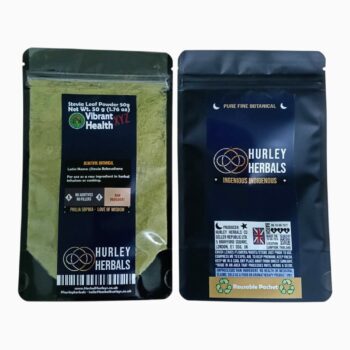
Ingredients: Stevia leaf (Stevia rebaudiana). Single ingredient. Nothing added.
Allergens: This product contains none of the 14 allergens that must be declared under UK law — celery, cereals containing gluten, crustaceans, eggs, fish, lupin, milk, molluscs, mustard, peanuts, sesame, soybeans, sulphur dioxide and sulphites, and tree nuts.
Stevia is an Asteraceae plant, the same family as ragweed, daisies, chrysanthemum and safflower. That is not a regulated allergen, but people who react to others in that family sometimes prefer to avoid it.
We publish this before you buy because we have to. Under Article 14 of assimilated Regulation (EU) 1169/2011, food sold at a distance must carry the same mandatory information as food bought in a shop, available free of charge before the purchase is concluded and again at delivery.
Nutrition declaration: Not required for this product. Annex V of assimilated Regulation (EU) 1169/2011 exempts all forms of tea and herbal infusions containing no added ingredients that would change nutritional value.
We value the rich heritage of herbal traditions that spans centuries. Our interest in herbs is informed by both historical practices and modern understanding of botanicals.
We source our ingredients from carefully selected suppliers who follow sustainable harvesting and cultivation practices. Our production methods are designed to preserve the natural qualities of our herbs through vacuum sealing and gentle processing techniques that maintain freshness and flavour integrity.
Our packaging is designed to be reused. Simply wash thoroughly after use.
Herb stocks are rotated annually to ensure freshness. Please note packaging may vary as we update our product range.
Store in a cool, dry place away from direct sunlight. Best before: see base of package. Whole leaf keeps its sweetness well — the glycosides are stable compounds and do not fade the way volatile aromatics do. Keep it airtight to stop it taking on moisture, which is what makes a dried leaf go limp rather than snap.
How much stevia leaf should I use?
Far less than you think. A quarter teaspoon sweetens a whole pot. Too much tastes cloying and bitter at once.
Is this the same as the white stevia powder?
No. That is isolated steviol glycosides, sold as the additive E960a. This is the whole dried leaf, which brings green herbal flavour and a liquorice edge along with the sweetness, and tints the water.
Why does it have an aftertaste?
Stevioside, the most abundant sweet compound in the leaf, carries most of the liquorice-like note. Refined sweeteners reduce it by isolating cleaner compounds such as rebaudioside A.
How sweet is it?
The steviol glycosides in the leaf are commonly cited at 200 to 300 times the sweetness of sucrose, and make up roughly 10 to 20% of the dry leaf.
Where does stevia come from?
Northeastern Paraguay and southern Brazil. The Guaraní have used it for more than 1,500 years, mainly to sweeten yerba mate. Commercial cultivation began in Paraguay only in 1964.
Can I bake with it?
Not easily. Whole leaf brings colour and herbal flavour, and it does not provide the bulk sugar gives. Steep it, strain it, and use the liquid.
Why does it taste green?
Because it is a leaf. Alongside the sweet glycosides you get the grassy character of any dried green leaf. In a blend that sits behind the other herb; on its own it is noticeable.
Does it contain allergens?
No. None of the 14 allergens that must be declared under UK law. Single ingredient, nothing added.
Last updated: 8 September 2026.
Botanical data cross-checked against Missouri Botanical Garden, Britannica and peer-reviewed reviews of Stevia rebaudiana cultivation and glycoside chemistry.
Raw ingredient. Packaging may vary. All herbs are marked with Batch ID, Picked Date and Best Before Date. No health claims made. Information on this website is for educational purposes only and is not intended as medical advice.
| Weight | 15 g |
|---|---|
| Dimensions | 15 × 2.5 × 22 cm |
| Colour | n/a |
| Herbal Extraction | n/a |
| Country of origin | Thailand |
| Ean | 680699850072 |
| Flavour | Aluminium Ziplock |
| Indigenous herbal use | Good Health |
| Indigenous stone use | n/a |
| Ingredients | Dried Stevia Leaves (Stevia Rebaudiana) |
| Metal | n/a |
| Semi precious stone | n/a |
| Tribe | n/a |
| Wild essential oil | n/a |
| Weight |
Only logged in customers who have purchased this product may leave a review.



There are no reviews yet.