RAW INGREDIENT
🛒 Buy 4 Save 20% – Mix & Match
Average UK Delivery Time: 1-3 Days
✈️ Free UK Delivery – Orders Over 25 GBP
📦 9.95 GBP Next Day Delivery (Orders before 12 noon)




Original price was: £9.99.£6.34Current price is: £6.34.
RAW INGREDIENT
🛒 Buy 4 Save 20% – Mix & Match
Average UK Delivery Time: 1-3 Days
✈️ Free UK Delivery – Orders Over 25 GBP
📦 9.95 GBP Next Day Delivery (Orders before 12 noon)
128 in stock
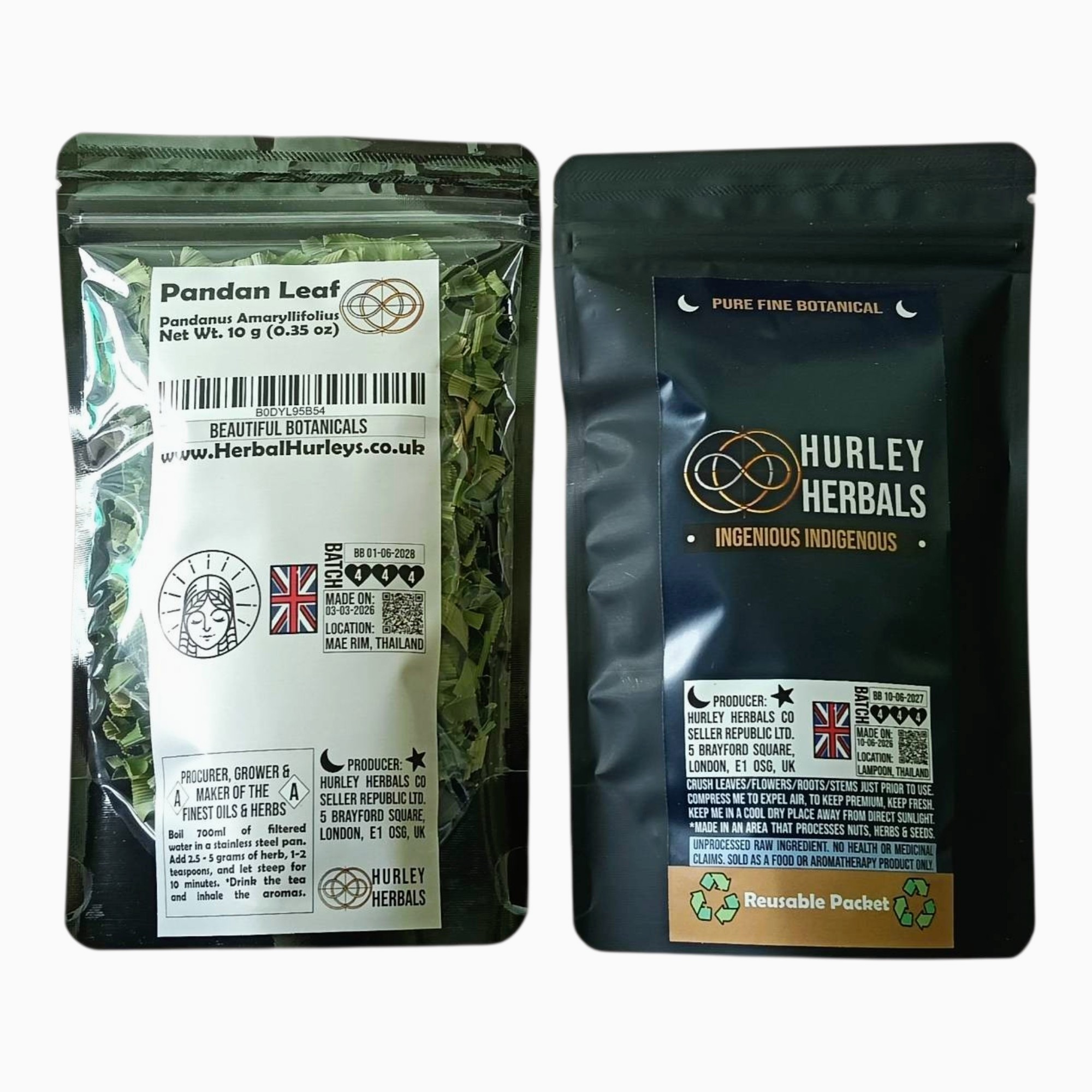
Pandan leaf is the dried leaf of Pandanus amaryllifolius — the only one of roughly 700 screwpine species whose leaves are fragrant. Its aroma comes from the same compound that makes basmati and jasmine rice smell the way they do, and it holds the highest recorded concentration of it in the plant kingdom.
Tie a few leaves in a knot, drop them into rice, coconut milk or syrup, and lift them out at the end. That is most of what there is to it. The knot is not decoration — it keeps the leaves together so you can find them again.
A small, spineless, clumping tropical perennial in the Pandanaceae family — the screwpines, named for the spiral arrangement of their leaves around the stem. It grows to around 1.5 metres, forming tight basal rosettes of arching, glossy, strap-shaped leaves typically 40 to 80cm long and 4 to 7cm wide.
Of the 600 to 750 species in the genus Pandanus, this is the only one with fragrant leaves. That single fact is why it is grown at all: almost every other screwpine is valued for fruit, fibre or shelter, and this one is grown for its smell.
Because there is no seed. No viable seed of P. amaryllifolius has ever been documented. The plant flowers so rarely that a single flowering at the Singapore Botanic Gardens in 1974 is cited as the recorded event, and male flowers have only been reported from New Guinea. Female flowers are unknown in the aromatic type.
It propagates entirely by suckers — roughly six to eight per plant per year. The consequence is remarkable: every pandan plant in every kitchen garden from Kerala to the Philippines is believed to descend from a single ancient clone, moved by hand for centuries. Like lemongrass, it is unknown in the wild.
Native to maritime Southeast Asia and southern India, in warm, humid lowland conditions across Indonesia, Malaysia, Thailand and the Philippines, extending into Papua New Guinea. It is usually grown in kitchen gardens and pots rather than in field-scale plantations, which is why almost all commercial supply comes from smallholders.
It reached India relatively late — introduced in 1798 through the Botanical Garden of Kolkata, and now cultivated along the Indian peninsula as a spice.
A compound called 2-acetyl-1-pyrroline, usually shortened to 2AP. It is the same molecule that gives basmati rice, jasmine rice and the crust of white bread their characteristic smell.
Pandan does not merely contain it. It accumulates 2AP at the highest concentration recorded in any plant, and its essential oil has been measured as carrying roughly ten times the aroma of highly scented rice and a hundred times that of ordinary rice.
The 2AP is stored in tiny bag-like structures called epidermal papillae on the underside of the leaf. That detail has a practical consequence: an intact fresh leaf smells of almost nothing. The aroma is released only once the leaf is withered, bruised, pounded or cooked — which is exactly what drying does, and why dried pandan gives up its scent the moment it hits hot liquid.
| Botanical name | Pandanus amaryllifolius |
| Also known as | Pandan, fragrant screwpine, daun pandan, bai toey |
| Family | Pandanaceae (screwpines) |
| Part used | Leaf, naturally dried |
| Origin | Thailand |
| Cultivation | Small local farms, traditional methods |
| Processing | Air dried to preserve the leaf aroma |
| Net weight | 15g |
| Aroma compound | 2-acetyl-1-pyrroline (2AP) |
| Aroma | Warm, nutty, vanilla and fresh-baked rice |
| Ingredients | Pandan leaves only. Nothing added. |
| On pack | Batch ID, picked date, best before date |
| Packed by | Seller Republic Limited (Vibrant Health XYZ), UK — general food business product or raw material |
| Packaging | Vacuum sealed, reusable |
Pandan is an infusing aromatic, not an ingredient you eat. It goes in, it gives up its scent, it comes out — the same job a bay leaf or a vanilla pod does.
Tie them in a knot before they go in the pot. Dried leaves are brittle, so soak them in warm water for 5 minutes first and they will bend rather than snap. The knot keeps the pieces together so you can retrieve them.
1 or 2 knotted leaves in with 2 cups of jasmine rice and the cooking water. It amplifies what is already there rather than adding a new flavour, because the compound is the same one the rice makes itself.
2 to 3 knotted leaves per 400ml of coconut milk. Bring gently to a simmer, hold 10 minutes, then lift them out. This is the classic route into kaya, sago pudding, coconut jelly and pandan custard.
3 knotted leaves per 250ml of 1:1 sugar syrup, steeped 30 minutes off the heat, then strained.
1 or 2 knotted leaves added with the coconut milk. Common in Malaysian and Indonesian rendang and gulai, where it sits underneath the chilli rather than competing with it.
The bright green of pandan cake comes from blending fresh leaves and straining the juice. Dried leaves give you the aroma but very little colour — use them for flavour and colour separately if you need both.
Dried leaf is what most UK cooks can actually get, and it works in every application above except colour extraction. As a working guide, use a similar leaf count to a fresh recipe and give it slightly longer in the pot.
We are not going to publish a precise dried-to-fresh conversion. Unlike lemongrass or bay, there is no consistent published ratio for pandan, and inventing one would be worse than leaving it out. Taste as you go — pandan is forgiving and difficult to overdo.
| Fresh leaf | Dried leaf | |
|---|---|---|
| Aroma | Released on bruising, pounding or cooking | Already released by drying — immediate in hot liquid |
| Preparation | Rinse and knot | Soak 5 minutes, then knot |
| Green colour | Yes, by blending and straining | Minimal |
| Best for | Cakes and anything needing colour | Rice, coconut milk, syrups, braises, tea |
| UK availability | Frozen, occasional | Always |
| Shelf life | Days refrigerated, months frozen | Months in the cupboard |
Yes, and it is common across Southeast Asia.
Tea House method, as supplied: add 1–2 tablespoons of leaves to 1 litre of water in a stainless steel pan. Bring to a boil and simmer for 5–10 minutes according to taste. The colour will deepen as it steeps. The herbs may be reused 2–4 times over the following 2 days, with flavour varying between brews.
Single cup: 1 knotted leaf per 250ml, water off the boil, 5 to 8 minutes. Mild, sweet and nutty. It is excellent iced with coconut water and it pairs naturally with anything vanilla.
This catches everyone who grows pandan and expects to walk past a fragrant plant. A living, undamaged leaf is almost odourless.
The reason is where the aroma is kept. 2AP is stored in tiny bag-like structures called epidermal papillae on the underside of the leaf, and it only escapes once those structures are broken. Pandan leaves release their scent when they are withered, bruised, pounded or cooked — not before.
Drying does that job permanently. It is the reason dried pandan gives up its aroma the instant it hits hot liquid, where a fresh leaf has to be knotted and bruised first to get going.
For the spiral. Pandanus species carry their leaves in a helix around the stem, and on the larger tree-forming species the twist is obvious enough that the whole genus got named for it. Nothing to do with pines, and nothing to do with screws beyond the shape.
Most of the 600 to 750 screwpines are coastal trees grown for fruit, fibre or shelter, many of them armed with vicious marginal spines. P. amaryllifolius is the outlier twice over: it is small, it is spineless, and it is the only one whose leaves are fragrant. It is grown for its smell alone.
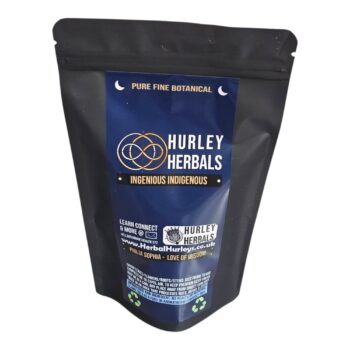
Ingredients: Pandan leaves (Pandanus amaryllifolius). Single ingredient. Nothing added.
Allergens: This product contains none of the 14 allergens that must be declared under UK law — celery, cereals containing gluten, crustaceans, eggs, fish, lupin, milk, molluscs, mustard, peanuts, sesame, soybeans, sulphur dioxide and sulphites, and tree nuts.
We publish this before you buy because we have to. Under Article 14 of assimilated Regulation (EU) 1169/2011, food sold at a distance must carry the same mandatory information as food bought in a shop, available free of charge before the purchase is concluded and again at delivery.
Nutrition declaration: Not required for this product. Annex V of assimilated Regulation (EU) 1169/2011 exempts herbs and spices, and all forms of tea and herbal infusions containing no added ingredients that would change nutritional value.
We value the rich heritage of herbal traditions that spans centuries. Our interest in herbs is informed by both historical practices and modern understanding of botanicals.
We source our ingredients from carefully selected suppliers who follow sustainable harvesting and cultivation practices. Our production methods are designed to preserve the natural qualities of our herbs through vacuum sealing and gentle processing techniques that maintain freshness and flavour integrity.
Our packaging is designed to be reused. Simply wash thoroughly after use.
Herb stocks are rotated annually to ensure freshness. Please note packaging may vary as we update our product range.
Store in a cool, dry place away from direct sunlight. Best before: see base of package. The aroma compound is volatile, so an airtight container matters more with pandan than with most dried leaves. If a leaf smells of nothing when you snap it, the 2AP has gone.
Why do you tie pandan leaves in a knot?
So you can find them again. Pandan is an infusing aromatic that gets lifted out before serving, and a knot keeps the pieces together in the pot. Soak dried leaves for 5 minutes first or they will snap rather than bend.
Why does pandan smell like rice?
Because it contains the same compound. 2-acetyl-1-pyrroline gives basmati and jasmine rice their aroma, and pandan holds the highest concentration recorded in any plant.
Can I eat pandan leaves?
No. They are fibrous and are used as an aromatic, then removed — like a bay leaf.
Will dried pandan colour my cake green?
Barely. The green of pandan cake comes from blending fresh leaves and straining the juice. Dried leaves deliver the aroma, not the colour.
Is pandan grown from seed?
No viable seed has ever been documented. It is propagated entirely from suckers, and all cultivated pandan is believed to descend from a single ancient clone.
Does it contain allergens?
No. None of the 14 allergens that must be declared under UK law. Single ingredient, nothing added.
How long does it keep?
Each pack carries a best before date on the base, alongside the batch ID and picked date. Store cool, dry, dark and airtight.
Last updated: 8 September 2026.
Botanical and aroma-chemistry data cross-checked against peer-reviewed literature on 2-acetyl-1-pyrroline in Pandanus amaryllifolius, iNaturalist and horticultural records.
Raw ingredient. Packaging may vary. All herbs are marked with Batch ID, Picked Date and Best Before Date. No health claims made. Information on this website is for educational purposes only and is not intended as medical advice.
| Weight | 10 g |
|---|---|
| Dimensions | 15 × 2.5 × 22 cm |
| Colour | n/a |
| Herbal Extraction | n/a |
| Country of origin | Thailand |
| Ean | 680699850034 |
| Flavour | Aluminium Ziplock |
| Indigenous herbal use | Good Health |
| Indigenous stone use | n/a |
| Ingredients | Dried Pandan Leaves (Pandanus Amaryllifolius) |
| Metal | n/a |
| Semi precious stone | n/a |
| Tribe | n/a |
| Wild essential oil | n/a |
| Weight |
Only logged in customers who have purchased this product may leave a review.


There are no reviews yet.