PURE RAW FINE BOTANICAL
RAW INGREDIENT
🛒 Buy 4 Save 20% – Mix & Match
Average UK Delivery Time: 1-3 Days
✈️ Free UK Delivery – Orders Over 25 GBP
📦 9.95 GBP Next Day Delivery (Orders before 12 noon)




Original price was: £9.99.£5.99Current price is: £5.99.
RAW INGREDIENT
🛒 Buy 4 Save 20% – Mix & Match
Average UK Delivery Time: 1-3 Days
✈️ Free UK Delivery – Orders Over 25 GBP
📦 9.95 GBP Next Day Delivery (Orders before 12 noon)
17 in stock
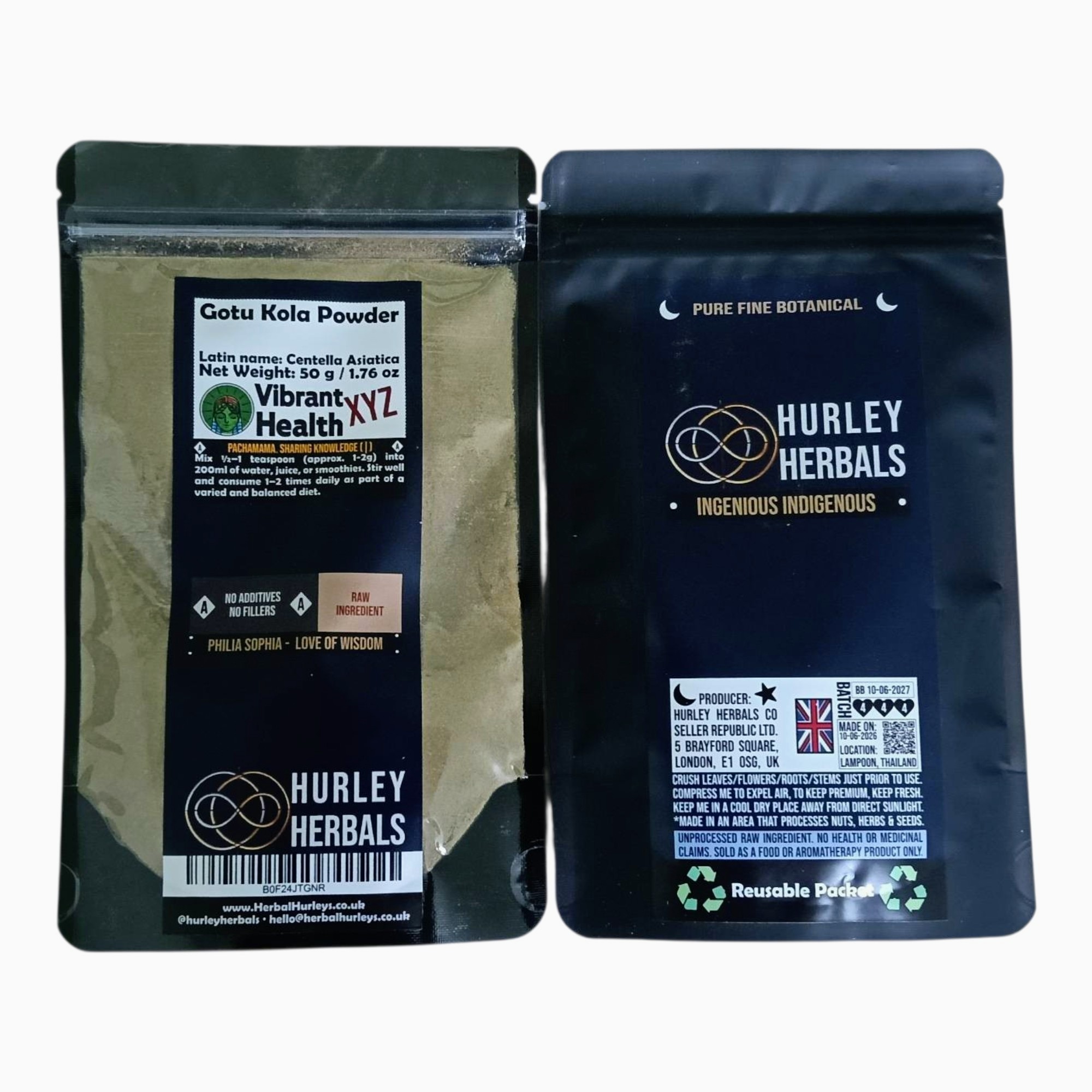
Gotu kola powder is milled dried leaf of Centella asiatica, a low creeping plant of tropical wetlands in the carrot family. A fine green powder, supplied as a raw botanical.
Milling changes what you can know about a material. This page is mostly about that — what a powder gains, what it costs you, and how to judge one when the leaf shape is no longer there to look at.
A perennial herb in the Apiaceae family — carrot, celery, fennel, coriander, dill. It reaches only 8 to 10cm tall but spreads indefinitely along creeping stolons that root at every node, forming a mat across wet ground rather than a clump.
Its leaves are rounded, fan to kidney-shaped, smooth, on stalks about 2cm long — the coin shape that gives it the names pennywort, coinwort and spadeleaf. The flowers are minute, under 3mm, carried in tiny umbels at soil level, and the umbel is what marks the family.
Native across tropical and subtropical Africa, Asia, Australia and the western Pacific, in swampy ground and along pond and river margins. The crop matures in about three months.
Three things, and they are worth separating.
It multiplies surface area. A whole leaf presents its outer face; a powder presents the whole interior of every fragment. Anything that acts on the material — solvent, water, air, light — acts faster.
It removes evidence. Leaf shape, venation, stem content and foreign matter are all assessable in whole leaf and none of them survive milling. A powder is a matter of trust in whoever made it.
It accelerates ageing. The same surface area that makes powder convenient exposes it to oxygen. Green powders fade faster than green leaves, and a khaki powder has usually been milled a long time ago rather than stored badly last week.
| Powder (this) | Whole dried leaf | |
|---|---|---|
| Identifiable by eye | No | Yes — shape and venation |
| Stem or stolon content | Unknowable | Visible |
| Adulteration risk | Higher | Lower — substitution shows |
| Surface area | Very high | Low |
| Disperses in liquid | Yes, then settles | No |
| Blends into a dry mix | Yes | No |
| Colour stability | Fades faster | Holds longer |
| Bulk per gram | Dense | Bulky and light |
Powder wins on convenience and on going into things. Whole leaf wins on verification. Neither is a better product; they answer different questions.
Without leaf shape to go on, four things are left.
| Check | Good | Poor |
|---|---|---|
| Colour | Deep green | Khaki, grey-green, or unnaturally bright |
| Smell | Green and vegetal, distinct | Dusty, flat, or of nothing |
| Texture | Fine and even, no grit between fingers | Gritty — soil, or coarse stem milled in |
| Behaviour in water | Disperses evenly, then settles as fine sediment | Clumps, floats as scum, or leaves sand at the bottom |
The grit test matters more for this plant than for most. Gotu kola grows flat on wet ground, so soil contamination is a real risk, and washing before drying is not optional. Grit that survives into a powder was never washed out and cannot be removed afterwards.
Because of how it was dried, and it is the clearest signal a powder gives you.
Leaf dried gently and out of direct sun keeps its chlorophyll and mills to a deep green. Leaf dried too hot, or dried slowly enough to start degrading, browns first and mills khaki. The colour of the powder is a record of the drying, not of the plant.
Light does the same thing after milling. A green powder stored in a clear jar on a windowsill will be khaki within months while an identical jar in a cupboard stays green.
This is where powder is at its weakest, because gotu kola carries three separate naming collisions and none of them are visible once milled.
All three are resolvable by eye in whole leaf and none of them are resolvable in powder. Buy powder on the binomial and on the supplier, because there is nothing else to go on.
Leaf is cut rather than the plant lifted — the stolon network stays in the ground and the bed regrows, which is why gotu kola is available year-round rather than seasonally. The cut material is separated from stolon and stalk, washed, dried, then milled and sieved.
The separation step decides the quality. Stolon is stringy and adds weight without adding leaf, and milling hides it completely. A powder made from poorly separated material is indistinguishable by eye from one made from clean leaf.
Ours is naturally dried and vacuum sealed.
One consequence of cutting rather than lifting is worth noting: the material is leaf from a mature, established bed rather than from a single harvest of whole plants. Beds cut repeatedly through the season produce more uniform leaf than a one-off lift, because the grower is taking the same growth stage each time.
Fine enough to disperse evenly and blend into a dry mix without separating out, which for leaf material means milling and then sieving to remove what did not pass.
What is sieved out is not waste, it is stem and midrib — the tough tissue that resists milling. That is why the sieving step matters as much as the milling: an unsieved powder carries the coarse fraction through into the pack, and it is exactly the fraction you would have separated out by hand at the leaf stage.
Rub a little between finger and thumb. An even, slightly slippery fineness is right. Anything you can feel as distinct particles is either coarse stem or grit, and neither belongs there.
Surface area, and it is not a small difference. Milling a leaf into powder exposes the entire interior of the tissue that was previously sealed inside a cuticle.
Oxygen reaches all of it at once, so oxidation that would take a whole leaf years takes a powder months. Chlorophyll degrades, the green goes to khaki, and the characteristic smell flattens. None of that makes the material unusable, but it does mean powder should be bought in quantities you will get through rather than stockpiled.
The practical rule: a whole leaf sitting in a jar is dormant, a powder is slowly reacting.
Vacuum sealing slows it considerably by removing most of the oxygen, which is why we pack this way rather than in a jar. Once the seal is broken that protection is gone, so decant into something airtight and keep it dark.
| Botanical name | Centella asiatica |
| Also known as | Gotu kola, Indian pennywort, coinwort, spadeleaf, brahmi |
| Former name | Hydrocotyle asiatica |
| Family | Apiaceae (carrot family) |
| Part used | Leaf |
| Form | Dried, milled to powder |
| Colour | Deep green |
| Origin | Thailand |
| Processing | Washed, naturally dried, milled, vacuum sealed |
| Net weight | 50g |
| Ingredients | Gotu kola leaf. Nothing added. |
| Supplied as | Raw botanical material |
| On pack | Batch ID, picked date, best before date |
| Packaging | Vacuum sealed, reusable |
Because it is hygroscopic, like every fine botanical powder. Milled plant material has an enormous surface area relative to its mass, and it pulls moisture out of the air through any gap in a seal.
Clumping is not spoilage and nothing is lost. Break the lumps up and the powder behaves normally. What it does tell you is that the container has been open or the seal has failed, and the same moisture that caused the clumping will shorten the material’s life.
Recorded rather than recommended.
Gotu kola is documented as a leaf vegetable across South and Southeast Asia — Sri Lanka, southern India, Thailand, Vietnam and Indonesia — where fresh leaf is used in salads and soups. The Sri Lankan preparation gotu kola sambola, fresh leaf shredded fine with coconut and lime, is the best-documented example.
It appears in classical Ayurvedic and traditional Chinese materia medica, and is grown commercially in several Asian countries today. That is the documented record and we make no claims arising from it.
This is a raw botanical. It is supplied as milled dried leaf, and no preparation instructions are given on this page.
Because it is not supplied as a food, no allergen declaration or nutrition information is provided — those requirements attach to food, and this is raw material.
Cool, dry, dark and airtight. Best before: see base of package. Dark storage matters more for a green powder than for almost anything else — light bleaches chlorophyll and a powder that has gone khaki has usually been in daylight. Keep the seal tight; it is hygroscopic and will clump if it takes on moisture.
Powder or whole leaf — which is better?
Neither. Powder disperses, blends into dry mixes and goes into things whole leaf cannot. Whole leaf lets you verify species, grade and stem content by eye. They answer different questions.
How do I judge a botanical powder?
Colour, smell, texture and behaviour in water. Deep green rather than khaki, a distinct green vegetal smell, fine and even with no grit between the fingers, and even dispersal that settles as fine sediment rather than sand.
Why does the colour matter?
It records the drying. Leaf dried gently and out of sun keeps its chlorophyll and mills deep green; leaf dried too hot browns first and mills khaki. Light does the same after milling.
Why is it gritty?
It should not be. Gotu kola grows flat on wet ground so soil contamination is a real risk and washing before drying is essential. Grit that survives into a powder was never washed out.
Is brahmi the same plant?
Sometimes. In India brahmi is used for both Centella asiatica and Bacopa monnieri, which are unrelated. In powder form neither is distinguishable by eye, so buy on the binomial.
Why has it clumped?
Moisture. Fine botanical powders are hygroscopic. Nothing is lost — break it up — but it means the seal has been open.
Does it dissolve?
No. It disperses and then settles, like any leaf powder. Whatever you add it to needs agitating.
Why is there no allergen or nutrition information?
Because those requirements attach to food. This product is supplied as raw botanical material.
We value the rich heritage of herbal traditions that spans centuries. Our interest in herbs is informed by both historical practices and modern understanding of botanicals.
We source our ingredients from carefully selected suppliers who follow sustainable harvesting and cultivation practices. Our production methods are designed to preserve the natural qualities of our botanicals through vacuum sealing and gentle processing techniques.
Our packaging is designed to be reused. Simply wash thoroughly after use.
Stocks are rotated annually. Please note packaging may vary as we update our product range.
Last updated: 8 September 2026.
Botanical data cross-checked against Wikipedia’s Centella asiatica entry, NC State Extension, CABI and published Apiaceae floras.
Raw botanical material. Packaging may vary. No health claims made. Information on this website is for educational purposes only and is not intended as medical advice.
| Weight | 50 g |
|---|---|
| Dimensions | 12 × 20 × 2 cm |
| Colour | n/a |
| Herbal Extraction | n/a |
| Country of origin | Thailand |
| Ean | B0F24JTGNR |
| Flavour | Gotu Kola Powder |
| Indigenous herbal use | Good Health |
| Indigenous stone use | n/a |
| Ingredients | Ground Dried Gotu Kola Leaves (Centella Asiatica) |
| Metal | n/a |
| Semi precious stone | n/a |
| Tribe | n/a |
| Wild essential oil | n/a |
| Weight |
Only logged in customers who have purchased this product may leave a review.


Dennis –
10 Stars
Ester –
5 Stars