RAW INGREDIENT
🛒 Buy 4 Save 20% – Mix & Match
Average UK Delivery Time: 1-3 Days
✈️ Free UK Delivery – Orders Over 25 GBP
📦 9.95 GBP Next Day Delivery (Orders before 12 noon)


Original price was: £9.99.£5.99Current price is: £5.99.
RAW INGREDIENT
🛒 Buy 4 Save 20% – Mix & Match
Average UK Delivery Time: 1-3 Days
✈️ Free UK Delivery – Orders Over 25 GBP
📦 9.95 GBP Next Day Delivery (Orders before 12 noon)
5 in stock
Moringa leaf powder is the milled dried leaf of Moringa oleifera, the drumstick tree. It tastes green and grassy with a peppery edge — closer to raw spinach with a hint of rocket than to anything sweet. Use it cold, or add it late.
The tree it comes from is a genuine oddity: a fast-growing, drought-proof native of the Himalayan foothills whose closest botanical relative is the papaya.
A fast-growing, drought-resistant deciduous tree in the Moringaceae family, reaching 10 to 12 metres with a trunk up to 46cm across. Moringaceae contains a single genus — Moringa — with around 13 species, of which oleifera is by far the most widely grown.
Here is the connection almost nobody makes: Moringaceae is closely related to Caricaceae, the papaya family. Moringa and papaya are botanical cousins, which explains rather a lot about why both are soft-wooded, fast-growing and short-lived.
For the pods. Moringa produces long, slender, triangular seed pods that hang from the branches like drumsticks, and in South Asia those pods are a vegetable in their own right — parboiled, cut short and cooked into curries and dals until soft. Their taste is usually described as reminiscent of asparagus with a hint of green beans.
It has two other common names, each earned. Horseradish tree, because the roots taste of horseradish. Ben oil tree, for the oil pressed from the seeds.
Almost every part gets eaten somewhere. The flowers are cooked and are said to taste of mushrooms; in West Bengal and Bangladesh they are a spring delicacy called sojne ful, cooked with peas and potato. The mature seeds are roasted like nuts.
The root. Despite the horseradish name and the practice of grating it as a condiment, moringa root contains the alkaloid spirochin, and reference sources describe the practice as one that should be strongly discouraged.
This product is leaf only. We mention the root because the horseradish name invites the question, and the honest answer is: not that part.
Native to the sub-Himalayan tracts of northwestern India and adjacent South Asia — roughly from northeastern Pakistan through Uttar Pradesh and Bihar to West Bengal and northeastern Bangladesh.
It has since been planted across the tropics: southwest Asia, Africa, Madagascar, the Philippines, the Caribbean, Central and South America. It wants 18 to 28°C and tolerates a wide rainfall range, roughly 760 to 2,500mm, which is why it establishes on marginal, semi-arid ground where more demanding trees fail.
It grows from seed or from stem cuttings, and it grows fast — which is the whole reason it spread.
Because it dries unusually well. Moringa leaves have low water content, which makes them quick to dry and easy to store — a practical advantage that most leafy greens do not have and the reason the powder became the standard export format.
| Botanical name | Moringa oleifera |
| Also known as | Drumstick tree, horseradish tree, ben oil tree, malunggay, murungai |
| Family | Moringaceae — sole genus, ~13 species |
| Part used | Leaf |
| Form | Dried, milled to powder |
| Origin | Thailand |
| Net weight | 50g |
| Colour | Deep green |
| Flavour | Grassy, spinach-like, peppery finish |
| Ingredients | Moringa leaf only. Nothing added. |
| On pack | Batch ID, picked date, best before date |
| Packed by | Seller Republic Limited (Vibrant Health XYZ), UK — general food business product or raw material |
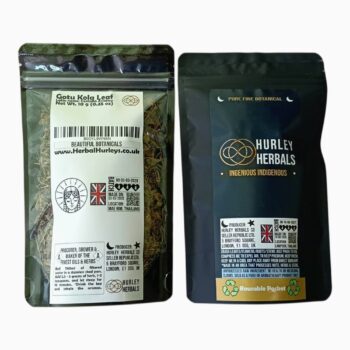
| Packaging | Vacuum sealed, reusable |
Two rules cover most of it. Start small, because the peppery finish builds. And add it late, because sustained heat dulls both the colour and the flavour.
½ to 1 teaspoon per 300ml, blended in at the end. It goes green immediately and it needs something with body — banana, mango or oat milk — to carry it. Citrus lifts it; pineapple works particularly well against the peppery note.
1 to 2 teaspoons per litre, stirred in during the last two minutes off a rolling boil. Add it early and you get a duller colour and a flatter taste.
Dusted over eggs, rice, roasted vegetables or hummus, the way you would use a green herb. This is where the flavour is at its best, because it has not been cooked at all.
1 tablespoon per 250g of flour for pasta, flatbread or pancakes. The colour survives baking better than it survives boiling.
1 teaspoon whisked into a lemon and olive oil dressing, or into yoghurt. Fat softens the peppery edge more effectively than sugar does.
Powder makes a cloudy, gritty infusion because there is nothing to strain out. If you want moringa as a drink, blend it into something rather than steeping it.
Green, grassy and vegetal with a peppery, faintly bitter finish. Most people find it agreeable in small quantities and overwhelming in large ones, which is why the advice above starts at half a teaspoon.
Moringa is unusual in that almost every part gets eaten somewhere, and the parts do not resemble each other at all. This pack is leaf. Here is where the rest sits.
| Part | How it is used | Tastes like |
|---|---|---|
| Leaf (this) | Cooked like spinach fresh; dried and milled into powder | Grassy, spinach-like, peppery finish |
| Pods — “drumsticks” | Parboiled, cut short, cooked into curries and dals | Asparagus with a hint of green beans |
| Flowers | Cooked; a spring delicacy in West Bengal and Bangladesh | Said to taste of mushrooms |
| Seeds | Roasted from mature pods, eaten like nuts | Bitter, prized for it in Nigeria |
| Seed oil | Ben oil — edible, also used industrially | Mild, very stable |
| Root | Do not. See below | — |
The root is the exception and it is worth repeating. Despite the horseradish tree name and the historical practice of grating it as a condiment, moringa root contains the alkaloid spirochin, and reference sources describe that practice as one that should be strongly discouraged. Leaf, pods, flowers and seeds are the edible parts.
Ingredients: Moringa leaf (Moringa oleifera). Single ingredient. Nothing added.
Allergens: This product contains none of the 14 allergens that must be declared under UK law — celery, cereals containing gluten, crustaceans, eggs, fish, lupin, milk, molluscs, mustard, peanuts, sesame, soybeans, sulphur dioxide and sulphites, and tree nuts.
We publish this before you buy because we have to. Under Article 14 of assimilated Regulation (EU) 1169/2011, food sold at a distance must carry the same mandatory information as food bought in a shop, available free of charge before the purchase is concluded and again at delivery.
Nutrition declaration: Not required for this product. Annex V of assimilated Regulation (EU) 1169/2011 exempts herbs, spices and flavourings, and unprocessed single-ingredient products.
Moringa is marketed elsewhere with a long list of claims attached. We make none of them. This is a dried leaf, milled, sold as a raw ingredient.
We value the rich heritage of herbal traditions that spans centuries. Our interest in herbs is informed by both historical practices and modern understanding of botanicals.
We source our ingredients from carefully selected suppliers who follow sustainable harvesting and cultivation practices. Our production methods are designed to preserve the natural qualities of our herbs through vacuum sealing and gentle processing techniques that maintain freshness and flavour integrity.
Our packaging is designed to be reused. Simply wash thoroughly after use.
Herb stocks are rotated annually to ensure freshness. Please note packaging may vary as we update our product range.
Store in a cool, dry place away from direct sunlight. Best before: see base of package. Dark storage matters for a green powder — light bleaches the colour, and a moringa powder that has gone olive or khaki has been sitting in daylight. Keep it airtight; like any fine powder it will clump if it takes on moisture.
How much moringa powder should I use?
Start at half a teaspoon per serving. The peppery finish builds, and it is easier to add than to take out.
What does moringa powder taste like?
Green and grassy, like raw spinach, with a peppery and faintly bitter finish. Not sweet, and not mild.
Can I make tea with it?
Not well. Powder gives a cloudy, gritty cup because there is nothing to strain out. Blend it into something instead.
Should I cook with it or add it raw?
Add it late. Sustained heat dulls both colour and flavour. Stir it in during the last two minutes, or use it as a finishing powder.
Why is it called the drumstick tree?
For its long, slender, triangular seed pods, which are eaten as a vegetable across South Asia and taste something like asparagus with a hint of green beans.
Is moringa related to papaya?
Yes, more closely than you would expect. Moringaceae is closely related to Caricaceae, the papaya family.
Can I eat the root?
No. Despite the horseradish name, moringa root contains the alkaloid spirochin, and reference sources describe grating it as a condiment as a practice that should be strongly discouraged. This product is leaf only.
Why has my powder gone khaki?
Light. Green powders bleach in daylight. Store it dark and it stays deep green.
Does it contain allergens?
No. None of the 14 allergens that must be declared under UK law. Single ingredient, nothing added.
Last updated: 8 September 2026.
Botanical data cross-checked against published reviews of Moringa oleifera, horticultural monographs and species databases.
Raw ingredient. Packaging may vary. All herbs are marked with Batch ID, Picked Date and Best Before Date. No health claims made. Information on this website is for educational purposes only and is not intended as medical advice.
| Weight | 50 g |
|---|---|
| Dimensions | 12 × 20 × 2 cm |
| Colour | n/a |
| Herbal Extraction | n/a |
| Weight | |
| Country of origin | Thailand |
| Ean | B0F24JCSZ1 |
| Flavour | Moringa Leaf Powder |
| Indigenous herbal use | Good Health |
| Indigenous stone use | n/a |
| Ingredients | Ground Dried Moringa Leaves (Moringa Oleifera) |
| Metal | n/a |
| Semi precious stone | n/a |
| Tribe | n/a |
| Wild essential oil | n/a |
Only logged in customers who have purchased this product may leave a review.


There are no reviews yet.