PURE RAW FINE BOTANICAL
RAW INGREDIENT
🛒 Buy 4 Save 20% – Mix & Match
Average UK Delivery Time: 1-3 Days
✈️ Free UK Delivery – Orders Over 25 GBP
📦 9.95 GBP Next Day Delivery (Orders before 12 noon)




Original price was: £9.99.£6.00Current price is: £6.00.
RAW INGREDIENT
🛒 Buy 4 Save 20% – Mix & Match
Average UK Delivery Time: 1-3 Days
✈️ Free UK Delivery – Orders Over 25 GBP
📦 9.95 GBP Next Day Delivery (Orders before 12 noon)
837 in stock
Sacred lotus is the dried flower of Nelumbo nucifera — and it is not a water lily. It sits in its own family, in an order whose other members are plane trees and proteas.
Supplied as a raw botanical. The plant behind it is one of the strangest in this catalogue: it heats its own flowers, its leaves cannot be wetted,Blue Lotus Flowereeds have germinated after thirteen centuries.
An aquatic perennial in the family Nelumbonaceae, in the order Proteales. It grows from rhizomes buried in the mud of slow rivers, lakes, deltas and marshes, sending leaves and flowers up above the water rather than floating them on it.
The leaves are enormous — up to 80cm across, on stalks running as long as 2 metres — and they are peltate: the stalk joins the blade at its centre rather than at an edge, so the veins radiate outward from the middle and split as they approach the margin.
Flowers are day-blooming, pink or white, held clear of the water, followed by the distinctive woody seed head that everyone recognises even without knowing the plant.
Because the resemblance is convergent rather than familial. Water lilies are Nymphaeaceae. Lotus is Nelumbonaceae, and the two families are very distantly related despite looking alike from a bank.
Lotus belongs to the order Proteales — whose other families include the plane trees and the proteas. Its nearest relatives are terrestrial trees and shrubs, not anything aquatic. The aquatic habit was arrived at independently.
There is a third collision worth knowing: the genus Lotus is a group of unrelated terrestrial legumes in the Fabaceae, including bird’s-foot trefoil. Three separate plant groups, one English word.
| Nelumbo nucifera (this) | Nymphaea | Lotus | |
|---|---|---|---|
| Family | Nelumbonaceae | Nymphaeaceae | Fabaceae |
| Common name | Sacred lotus | Water lily — incl. lotus | Trefoil |
| Leaves | Held above water, peltate | Float, notched to the stalk | Terrestrial, compound |
| Related to | Plane trees, proteas | Other water lilies | Peas and beans |
That middle column matters commercially. Nymphaea caerulea, lotus, is a water lily and a different plant with different chemistry. This is the sacred lotus.
Ancient. Nelumbo is known from fossils dating back to the Early Cretaceous, with dozens of extinct species described — and only two living ones remain: N. nucifera across Asia, and N. lutea in North America.
It is a relict, in other words: a survivor of a formerly diverse lineage. That is unusual enough on its own, and it comes alongside a second kind of longevity.
Yes, and the figures are documented rather than folkloric.
Researchers recovered single-seeded fruits of the China Antique variety from a dry lakebed in northeastern China. Direct radiocarbon dating put them at around 1,300 years old, and they germinated at a rate of 84%.
The mechanism is partly the pericarp — the tough fruit tissue enclosing each seed — which is considered a major factor in the longevity, alongside unusually heat-stable protective proteins inside.
Kew notes the same property more simply: seeds burst into life from beneath riverbed mud after hundreds of years of dormancy, and it is that persistence, as much as the flower, behind the plant’s place in religious art across Asia.
The reason a lotus leaf cannot get dirty, and one of the clearest cases of a plant inspiring an industrial material.
The leaf surface carries microscopic bumps called papillae, themselves coated in tough waxy tubes at nanoscale. Water cannot spread across a surface structured like that; it beads into near-spheres and rolls off, and rolling droplets pick up dirt particles as they go.
The leaf therefore cleans itself. A lotus growing in the murkiest swamp stays pristine, which is precisely why the plant became a symbol of purity long before anyone could explain the physics.
The effect has been reverse-engineered. Self-cleaning surfaces developed from it include the industrial facade paint Lotusan, and lotus remains one of the standard reference organisms in superhydrophobic surface research.
They do, and this is the property that most surprises people.
Sacred lotus flowers are thermogenic — they produce heat and regulate their own temperature. Kew records them holding above 30°C on cold mornings; published work describes the flower maintaining a relatively stable temperature despite large swings in the surrounding air.
The function is pollination. A warm flower on a cold morning is an attractive place for an insect to be, and warmth also volatilises scent. Thermoregulation is rare among flowering plants and lotus is one of the textbook examples.
Native across tropical and subtropical Asia — the Indian subcontinent, China, Southeast Asia and Japan — and into northern Australia, in sheltered freshwater lagoons, floodplains and seasonally flooded ground.
It wants full sun, warm water and heavy clay or loam beneath, and it tolerates a broad pH range with a preference for slightly acidic to neutral conditions.
It was domesticated in Asia around 7,000 years ago and has been grown for its rhizomes and seeds ever since, which makes it one of the oldest cultivated plants in this catalogue.
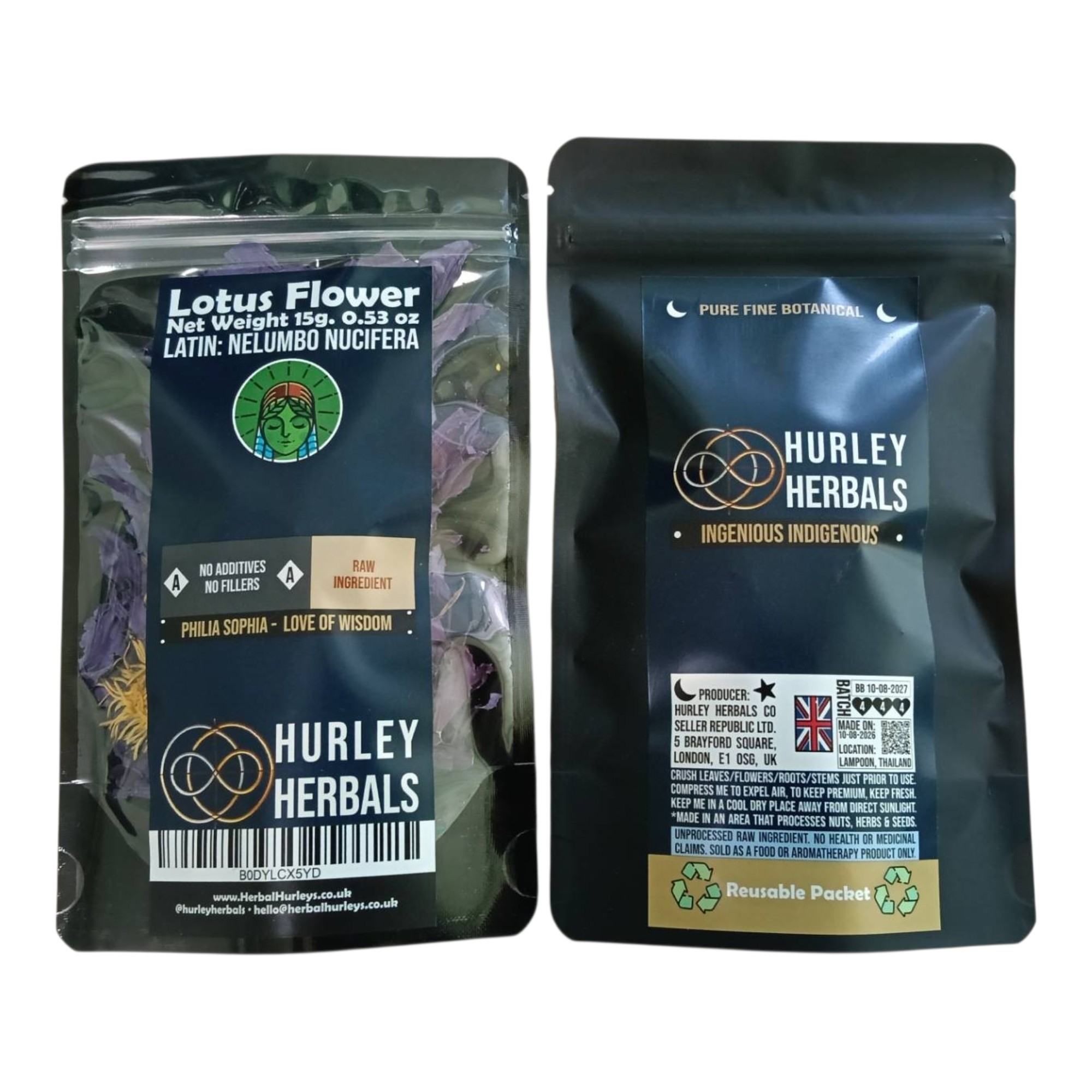
The flower, dried whole. Not the rhizome, which is the vegetable sold as lotus root; not the seed; and not the leaf.
Dried lotus flower is light, layered and fragile. The petals separate readily and the material is bulkier per gram than almost anything else in this range, so 15g occupies a surprising amount of space.
That fragility is worth planning for. Whole flowers packed loose will break down into petals in transit and in storage, which changes nothing about the material but does remove the one visual feature that lets you confirm what you have. Keep them in something rigid rather than a bag under other stock.
| Check | Good | Poor |
|---|---|---|
| Form | Whole flowers, petals attached | Loose petal fragments only |
| Colour | Retained pink or cream | Uniform brown — over-dried or old |
| Texture | Papery, springs slightly | Brittle dust, or limp |
| Foreign matter | None | Pond debris, grit |
| Species evidence | Sold with the binomial | “Lotus” alone — could be Nymphaea |
That last row is the important one. Given that sacred lotus is a water lily and a different plant, a product labelled only “lotus” tells you nothing about which family you have bought from.
| Botanical name | Nelumbo nucifera Gaertn. |
| Also known as | Sacred lotus, Indian lotus, Asian lotus, lian ou, hasu |
| Family | Nelumbonaceae, order Proteales |
| Living species in genus | Two — N. nucifera and N. lutea |
| Not | A water lily. Not Nymphaea, not Nymphaea caerulea. |
| Part used | Flower |
| Form | Whole, dried |
| Native range | Tropical and subtropical Asia, northern Australia |
| Domesticated | Asia, around 7,000 years ago |
| Net weight | 15g |
| Ingredients | Sacred lotus flower. Nothing added. |
| Supplied as | Raw botanical material |
| On pack | Batch ID, picked date, best before date |
| Packaging | Vacuum sealed, reusable |
Because it is not really an aquatic plant by ancestry. Its relatives are terrestrial trees and shrubs, and lotus kept the architecture of a land plant while moving into water.
A water lily floats its leaves, which is the efficient aquatic solution. Lotus builds a stalk up to two metres long and holds the blade in the air — expensive, and only worth doing if the plant is working from a terrestrial blueprint.
The self-cleaning surface makes more sense in that light too. An emergent leaf in a floodplain gets splashed with silt; one that sheds water sheds the silt with it.
Recorded rather than recommended.
Sacred lotus has been cultivated in Asia for roughly 7,000 years, principally for its rhizomes and seeds as food crops. Its rhizome is lotus root, eaten across China, Japan and Korea; its seeds are eaten fresh, dried and in confectionery.
Its cultural presence is older than most written records — it appears throughout religious art across Asia as a symbol of purity and rebirth, and the seed longevity and self-cleaning leaves are both plausible sources of that symbolism.
It is also studied as a candidate for nature-based water treatment, filtering heavy metals and suppressing algal growth — a modern application arising from the same tolerance of silty, variable water that shaped the leaf surface.
That is the documented record. We make no claims arising from it.
This is a raw botanical. It is supplied as whole dried flower, and no preparation instructions are given on this page.
Because it is not supplied as a food, no allergen declaration or nutrition information is provided — those requirements attach to food, and this is raw material.
Cool, dry, dark and in a rigid container. Best before: see base of package. Whole dried flowers are the most fragile material in this range — crushed under weight they become petal fragments and lose the form that identifies them. Light also fades what colour the petals retain.
Is sacred lotus a water lily?
No. Water lilies are Nymphaeaceae. Sacred lotus is Nelumbonaceae, in the order Proteales, whose other members include plane trees and proteas. The resemblance is convergent.
Is this the same as blue lotus?
No. Blue lotus is Nymphaea caerulea, a water lily, and a different plant with different chemistry. This is Nelumbo nucifera.
Do lotus seeds really survive centuries?
Yes. Seeds recovered from a dry lakebed in northeastern China were radiocarbon-dated to about 1,300 years old and germinated at 84%. The tough pericarp enclosing each seed is considered a major factor.
What is the lotus effect?
The leaf’s self-cleaning water repellency. Microscopic papillae coated in waxy nanotubes stop water spreading, so droplets bead and roll off carrying dirt with them. It inspired self-cleaning materials including the facade paint Lotusan.
Do lotus flowers produce heat?
Yes. They are thermogenic and regulate their own temperature, holding above 30°C on cold mornings. The warmth attracts pollinating insects and helps volatilise scent.
How many lotus species are there?
Two living ones — Nelumbo nucifera across Asia and Nelumbo lutea in North America. Dozens more are known only from fossils dating to the Early Cretaceous.
Which part is in this pack?
The flower, dried whole. Not the rhizome sold as lotus root, not the seed and not the leaf.
Why is there no allergen or nutrition information?
Because those requirements attach to food. This product is supplied as raw botanical material.
We value the rich heritage of herbal traditions that spans centuries. Our interest in herbs is informed by both historical practices and modern understanding of botanicals.
We source our ingredients from carefully selected suppliers who follow sustainable harvesting and cultivation practices. Our production methods are designed to preserve the natural qualities of our botanicals through vacuum sealing and gentle processing techniques.
Our packaging is designed to be reused. Simply wash thoroughly after use.
Stocks are rotated annually. Please note packaging may vary as we update our product range.
Last updated: 8 September 2026.
Botanical data cross-checked against Royal Botanic Gardens Kew, Brooklyn Botanic Garden, the National Tropical Botanical Garden and published research on Nelumbo seed longevity, floral thermoregulation and superhydrophobic surfaces.
Raw botanical material. Packaging may vary. No health claims made. Information on this website is for educational purposes only and is not intended as medical advice.
| Weight | 10 g |
|---|---|
| Dimensions | 12 × 20 × 2 cm |
| Colour | n/a |
| Herbal Extraction | n/a |
| Country of origin | Thailand |
| Ean | 680699850096 |
| Flavour | Blue Lotus |
| Indigenous herbal use | Good Health |
| Indigenous stone use | n/a |
| Ingredients | Dried Blue Lotus Flowers (Nymphaea Caerulea) |
| Metal | n/a |
| Semi precious stone | n/a |
| Tribe | n/a |
| Wild essential oil | n/a |
Only logged in customers who have purchased this product may leave a review.



John S –
Love it
Abdul –
Great quality
Stevie –
Thank you!
Donald –
Will be stocking up!
Stevie G –
Lovely cuppa