PURE RAW FINE BOTANICAL
RAW INGREDIENT
🛒 Buy 4 Save 20% – Mix & Match
Average UK Delivery Time: 1-3 Days
✈️ Free UK Delivery – Orders Over 25 GBP
📦 9.95 GBP Next Day Delivery (Orders before 12 noon)

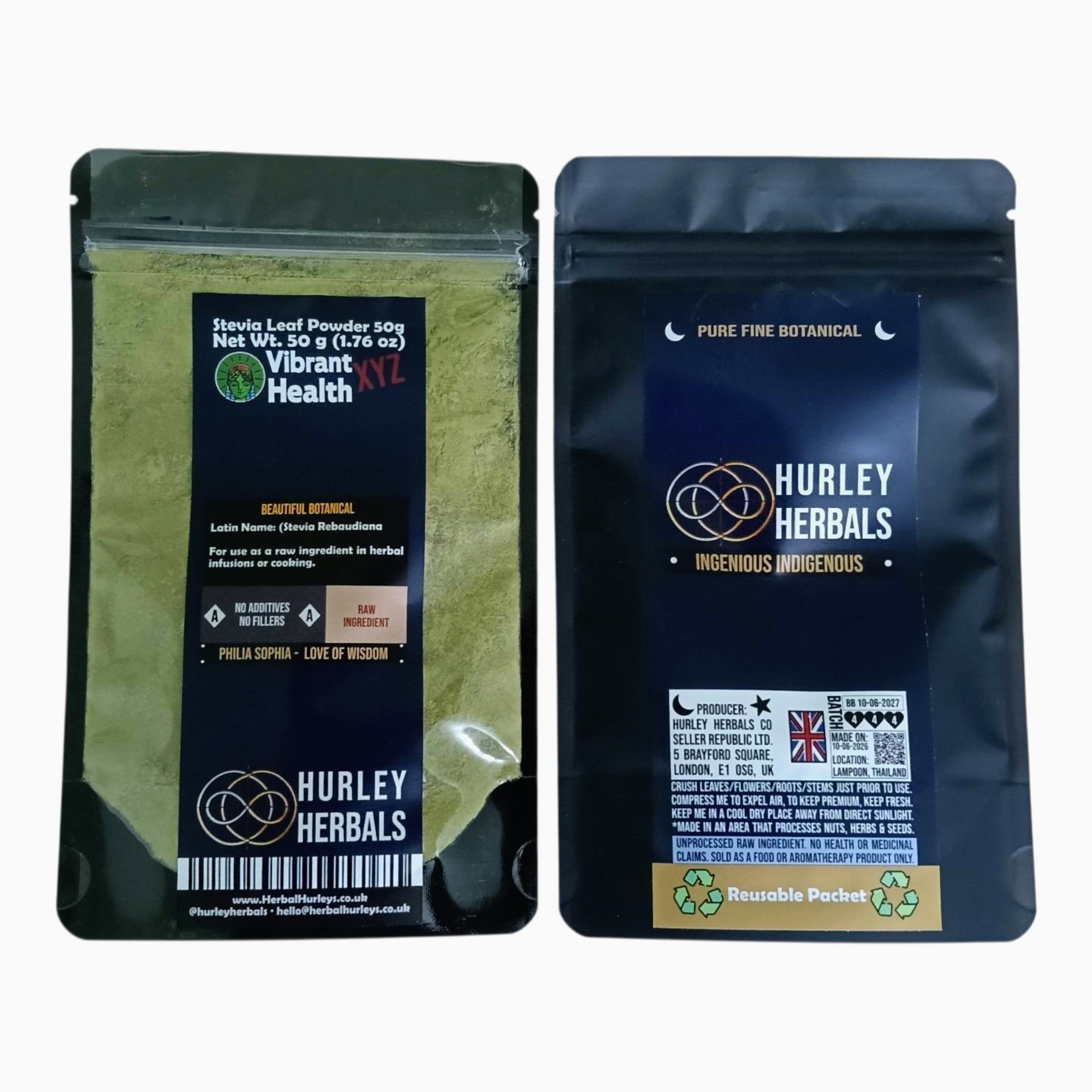

Original price was: £9.99.£5.99Current price is: £5.99.
RAW INGREDIENT
🛒 Buy 4 Save 20% – Mix & Match
Average UK Delivery Time: 1-3 Days
✈️ Free UK Delivery – Orders Over 25 GBP
📦 9.95 GBP Next Day Delivery (Orders before 12 noon)
11 in stock
Stevia leaf powder is milled dried leaf of Stevia rebaudiana, a small shrub from northeastern Paraguay. Whole leaf, ground — not a refined extract, and a fundamentally different material from the white powder sold as a sweetener.
That difference is the point of this page. Two things called stevia powder sit on shop shelves and they are not the same substance, not made the same way, and not regulated the same way.
A tender perennial herb in the Asteraceae family — the daisy and sunflower family, alongside lettuce, chrysanthemum and safflower. It is small and unremarkable: 30 to 60cm on weak, floppy stems with small white flowers, and the Missouri Botanical Garden notes drily that the plants have little ornamental attraction.
The genus is large, somewhere between 154 and 240 species depending on the authority. Only this one is grown for sweetness at scale, and it is the leaves rather than any other part that carry it.
Northeastern Paraguay and adjacent southern Brazil, in subtropical conditions. The Guaraní name is ka’a he’ê, sweet herb, and they have used the plant for over 1,500 years.
Commercial cultivation is startlingly recent for something that old in use. The first commercial crop was reported in Paraguay in 1964; serious cultivation in Japan followed from 1971. It now grows across Asia, Europe and the Americas.
Everything except the plant they started from.
| Green leaf powder (this) | White stevia powder | |
|---|---|---|
| What it is | The whole leaf, dried and milled | Isolated steviol glycosides |
| Colour | Green | White |
| Made by | Drying and milling | Extraction and purification |
| Carries an E number | No | Yes — E960a |
| Other plant material | All of it | Removed |
| Colour transfer | Tints whatever it goes into | None |
| Bulk | Leaf bulk | Almost none — used in fractions of a gram |
If a recipe or a product calls for stevia and expects an invisible white powder used a pinch at a time, it means the extract. This is the leaf.
Steviol glycosides — a family of about ten related diterpene compounds including stevioside, rebaudioside A and dulcoside A. Between them they make up roughly 10 to 20% of the dry leaf.
Their sweetness by weight is extraordinary: commonly cited at 200 to 300 times sucrose, with individual compounds ranging from 30 to 450 times depending on which one and how it is measured. None is metabolised for energy.
They do not taste alike. Stevioside is the most abundant and carries most of the liquorice-like note; rebaudioside A is cleaner. Refined sweeteners are built by isolating the cleaner compounds. A milled whole leaf contains all of them in the proportions the plant made them, which is why it does not taste like a sachet.
Because the extract is the sweet fraction with everything else stripped out — chlorophyll, fibre, minerals, the lot. What is left is a purified compound, and purified steviol glycosides are colourless.
Green leaf powder carries the whole leaf. That means colour, a green vegetal flavour alongside the sweetness, and the bulk of the leaf tissue itself. Whether that is a feature or a nuisance depends entirely on what you are doing with it.
By destination, and this is a detail from inside the trade rather than from marketing.
Producers grow one crop and split it after cleaning. Leaf destined for extraction goes forward unprocessed — the extraction does not care about cut size. Leaf destined for tea and infusion goes through additional sorting for cut size and milling.
A published life-cycle study of a Paraguayan cooperative describes exactly that split: around 180 tonnes of dried stevia leaf annually, roughly 40% sold for extraction and the remaining 60% to companies selling stevia-based teas and infusions.
The practical consequence is that leaf-grade material is sorted and leaf sold for extraction is not. Powder made from properly sorted leaf is a different product from powder made from extraction feedstock, even though both are honestly described as milled stevia leaf.
| Check | Good | Poor |
|---|---|---|
| Colour | Deep green | Khaki, grey, or bleached pale |
| Texture | Fine and even | Gritty, or coarse fibrous flecks |
| Smell | Green, faintly sweet, hay-like | Dusty or of nothing |
| Stem content | Not visible | Pale fibrous specks through the green |
| In water | Disperses, tints, settles fine | Sand at the bottom |
Stem is the specific thing to look for here. Stevia stems are woody relative to the leaf and carry far less glycoside, so stem milled in is dilution. In a green powder it shows as pale fibrous specks rather than uniform colour.
Less than you would expect, and this sets stevia apart from most botanicals.
Steviol glycosides are stable compounds rather than volatile oils. A jar of stevia leaf holds its sweet character long after an aromatic herb in the same cupboard has gone flat, because there is nothing volatile to evaporate.
What does change is the green note, which fades first. The practical effect is that older material can read marginally cleaner and sweeter rather than weaker — one of very few dried botanicals where a little age is not a loss.
Colour is the exception. Like any green powder it bleaches in daylight, so a khaki stevia powder has been in the light even if it still tastes right.
Because sweetness costs it almost nothing. Steviol glycosides are secondary metabolites — compounds a plant makes for defence rather than for growth — and they are effective at concentrations of a few percent of dry weight.
The plant does not need to be large, or fleshy, or to store anything. A floppy 60cm herb with unremarkable leaves produces a compound hundreds of times sweeter than cane sugar, while sugar cane itself has to build metres of dense stem to hold what it makes.
That efficiency is why stevia moved from a regional Paraguayan plant to a global crop within a few decades of anyone outside South America paying attention to it.
Because stevia leaf is not uniform material. The blade is thin and mills easily; the midrib and stem are fibrous and resist, and they carry far less glycoside than the leaf around them.
A mill run without separation pushes both through, and the fibrous fraction ends up in the pack as pale flecks — visible against green, and pure dilution. Proper production separates leaf from stem before milling and sieves afterwards to catch what came through anyway.
This is why cut size sorting exists as a distinct trade step for infusion-grade stevia and not for extraction feedstock. The extractor does not care what fraction the glycosides come out of; anyone selling leaf does.
| Botanical name | Stevia rebaudiana |
| Also known as | Stevia, sweetleaf, ka’a he’ê |
| Family | Asteraceae (daisy family) |
| Part used | Leaf |
| Form | Dried, milled to powder |
| Not | An extract. No E number, no purification. |
| Sweet compounds | Steviol glycosides, roughly 10–20% of dry leaf |
| Origin | Thailand |
| Processing | Naturally dried, milled, vacuum sealed |
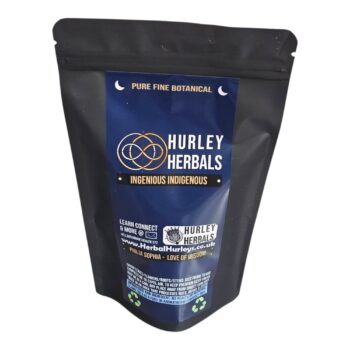
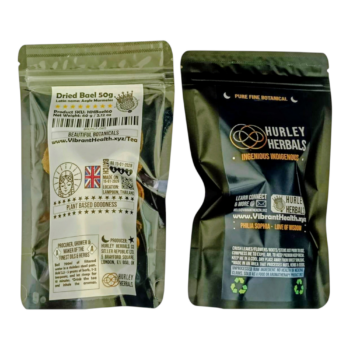
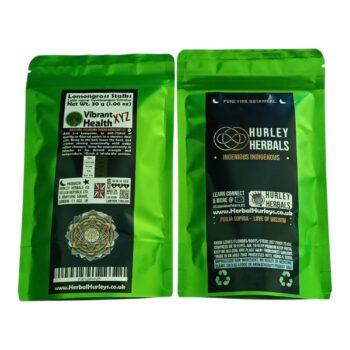
| Net weight | 60g |
| Ingredients | Stevia leaf. Nothing added. |
| Supplied as | Raw botanical material |
| On pack | Batch ID, picked date, best before date |
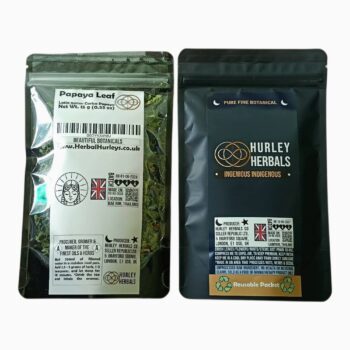
| Packaging | Vacuum sealed, reusable |
Hygroscopy, like every fine botanical powder. Milled plant material has enormous surface area relative to mass and pulls moisture out of the air through any gap in a seal.
Clumping is not spoilage and nothing is lost — break it up and it behaves normally. It does tell you the seal has been open, and the same moisture that caused it will shorten the material’s life.
Recorded rather than recommended.
The Guaraní of Paraguay and Brazil have used the leaf for more than 1,500 years, chiefly to sweeten yerba mate and other bitter preparations. The plant was described to Western botany at the end of the nineteenth century and named for the Swiss botanist Moisés Bertoni, who documented it.
Commercial history begins in 1964 in Paraguay and 1971 in Japan, where stevia was adopted at industrial scale decades before Western markets took it up. That is the documented record; we make no claims arising from it.
This is a raw botanical. It is supplied as milled dried leaf, and no preparation instructions are given on this page.
Because it is not supplied as a food, no allergen declaration or nutrition information is provided — those requirements attach to food, and this is raw material.
Cool, dry, dark and airtight. Best before: see base of package. The sweetness is unusually stable because the glycosides are not volatile, but the green colour is not — daylight bleaches it toward khaki over months. Keep the seal tight; it is hygroscopic and will clump if it takes on moisture.
Is this the same as white stevia powder?
No. White stevia powder is isolated steviol glycosides sold as the additive E960a. This is the whole dried leaf, milled — green, with the plant’s own flavour and colour, and no E number.
Why is it green?
Because it is the whole leaf. The extract is the sweet fraction with chlorophyll, fibre and everything else stripped out, and purified steviol glycosides are colourless.
What makes stevia leaves sweet?
Steviol glycosides, about ten related compounds including stevioside and rebaudioside A, making up roughly 10 to 20% of the dry leaf. Commonly cited at 200 to 300 times the sweetness of sucrose.
Why does whole leaf taste different from the sachet?
Stevioside is the most abundant compound in the leaf and carries most of the liquorice-like note. Refined sweeteners isolate cleaner compounds such as rebaudioside A. Whole leaf gives you all of them in the plant’s own proportions.
How do I judge the quality?
Deep green rather than khaki, fine and even with no grit, a green faintly sweet hay-like smell, and no pale fibrous specks. Those specks are milled stem, which carries far less glycoside than leaf.
Does the sweetness fade?
Far less than aroma fades in other herbs, because steviol glycosides are stable rather than volatile. The green note fades first, so older material can read cleaner rather than weaker.
Why has it clumped?
Moisture. Fine botanical powders are hygroscopic. Nothing is lost, but it means the seal has been open.
Why is there no allergen or nutrition information?
Because those requirements attach to food. This product is supplied as raw botanical material.
We value the rich heritage of herbal traditions that spans centuries. Our interest in herbs is informed by both historical practices and modern understanding of botanicals.
We source our ingredients from carefully selected suppliers who follow sustainable harvesting and cultivation practices. Our production methods are designed to preserve the natural qualities of our botanicals through vacuum sealing and gentle processing techniques.
Our packaging is designed to be reused. Simply wash thoroughly after use.
Stocks are rotated annually. Please note packaging may vary as we update our product range.
Last updated: 8 September 2026.
Botanical data cross-checked against Missouri Botanical Garden, Britannica, published reviews of Stevia rebaudiana glycoside chemistry and a peer-reviewed life-cycle study of European stevia production.
Raw botanical material. Packaging may vary. No health claims made. Information on this website is for educational purposes only and is not intended as medical advice.
| Weight | 50 g |
|---|---|
| Dimensions | 12 × 20 × 2 cm |
| Colour | n/a |
| Herbal Extraction | n/a |
| Country of origin | Thailand |
| Ean | B0F24KQLM9 |
| Flavour | Stevia Leaf Powder |
| Indigenous herbal use | Good Health |
| Indigenous stone use | n/a |
| Ingredients | Stevia Leaf Powder |
| Metal | n/a |
| Semi precious stone | n/a |
| Tribe | n/a |
| Wild essential oil | n/a |
| Weight |
Only logged in customers who have purchased this product may leave a review.


There are no reviews yet.