RAW INGREDIENT
🛒 Buy 4 Save 20% – Mix & Match
Average UK Delivery Time: 1-3 Days
✈️ Free UK Delivery – Orders Over 25 GBP
📦 9.95 GBP Next Day Delivery (Orders before 12 noon)




Original price was: £9.99.£5.99Current price is: £5.99.
RAW INGREDIENT
🛒 Buy 4 Save 20% – Mix & Match
Average UK Delivery Time: 1-3 Days
✈️ Free UK Delivery – Orders Over 25 GBP
📦 9.95 GBP Next Day Delivery (Orders before 12 noon)
17 in stock
Makrut lime leaf, sold here as kaffir lime, is the dried double leaf of Citrus hystrix — the aromatic backbone of Thai soups and curries. Two dried leaves replace one fresh. This 15g pack holds enough for dozens of dishes.
The leaf does what no zest can. It carries citrus and a floral, slightly bitter edge that survives a long simmer, which is why a tom yum tastes hollow without it and no amount of lime juice fixes that.
We list this as kaffir lime because that is what most UK customers search for. It is worth knowing that kaffir is a racial slur in South Africa, and much of the food world has moved to makrut lime, from the Thai makrut. Both names appear on this page for that reason. The plant is the same.
A thorny, multi-stemmed evergreen shrub or small tree in the Rutaceae family — the true citrus family, alongside lemons and oranges. The Missouri Botanical Garden gives its height as 6 to 25 feet, roughly 1.8 to 7.5 metres, though cultivated trees are usually kept far smaller.
Its species name tells you what it looks like. Hystrix is Greek for hedgehog, and it refers both to the thorns along the branches and to the deeply warty, bumpy skin of the fruit.
Because botanically it almost is. What looks like one long leaf pinched in the middle is a leaf blade joined to a broad winged petiole — the stalk itself has flattened out and gone green. The result is the hourglass shape that makes the plant instantly recognisable and makes the leaf impossible to confuse with anything else in a spice cupboard.
Both halves are aromatic. When a recipe says four leaves, it means four of these double units.
Native to tropical Southeast Asia — Indonesia, Thailand, Malaysia, Cambodia, Vietnam and the Philippines. The Missouri Botanical Garden notes it has naturalised widely across the tropics and that the specific location of its original distribution is uncertain.
It wants full sun, sandy well-drained soil and abundant rainfall, sheltered from strong wind. It is hardy only to USDA zones 10 to 12. Trees tolerate an occasional dip to freezing but generally will not survive much below it, which is why the UK sees the leaves and not the trees.
Citronellal, which makes up the large majority of the leaf’s essential oil. That single compound is why the aroma reads as citrus rather than as a green herb, and why it holds up under heat where lime juice simply evaporates.
One counterintuitive detail: dried leaves yield more essential oil by weight than fresh — around 1.38% against 0.98% — because the water has gone. What drops is the volatile top note you get when you tear a fresh leaf. That is the trade-off, and it is why dried belongs in long-cooked dishes rather than finishing.
| Botanical name | Citrus hystrix |
| Also known as | Makrut lime, Thai lime |
| Family | Rutaceae (true citrus) |
| Part used | Whole double leaves, naturally dried |
| Origin | Thailand |
| Cultivation | Small local farms, traditional methods |
| Processing | Air dried to preserve the leaf oils |
| Net weight | 15g |
| Aroma | Sharp citrus, floral, faintly bitter |
| Ingredients | Makrut lime leaves only. Nothing added. |
| On pack | Batch ID, picked date, best before date |
| Packed by | Seller Republic Limited (Vibrant Health XYZ), UK — general food business product or raw material |
| Packaging | Vacuum sealed, reusable |
Tear them. Fold each leaf and tear down either side of the central vein before it goes in the pot. Whole and intact, a leaf gives up very little. Torn, it releases along the break.
Or rehydrate. Soak in warm water for 10 to 15 minutes and the leaf becomes pliable enough to slice or pound like a fresh one.
8 to 12 dried leaves per 3 cups of broth, torn. Add most of them early with the galangal and lemongrass, and hold two back until 5 minutes before serving for a fresher top note. Lift them out before it goes to the table — a whole leaf is not meant to be eaten.
8 to 12 torn leaves, in once the paste has been fried off and the coconut milk has gone in. Simmer 5 to 10 minutes.
Rehydrate 4 to 8 leaves, strip out the central vein, then pound or blitz straight into the paste. Pounding the leaf into the paste as well as adding it to the pot doubles the citrus.
Rehydrate, remove the vein, and slice as fine as you can manage — sliced to a thread, the leaf is meant to be eaten rather than fished out. This is the one application where fresh genuinely outperforms dried.
4 to 6 torn leaves in with the coconut milk. Out before serving.
Roughly 2 dried leaves per 1 fresh leaf. Dried retains an estimated 40 to 50% of the aromatic intensity of fresh, so a recipe calling for 4 to 6 fresh leaves wants 8 to 12 dried.
Sources are not unanimous on this. Most put dried well below fresh in aroma and advise increasing the count; one advises the opposite. We follow the majority, and the physical reason behind it — citronellal is volatile and some is lost in drying.
| Fresh leaf | Dried leaf | |
|---|---|---|
| Equivalent | 1 leaf | 2 leaves |
| Aroma retained | 100% | Estimated 40–50% |
| Preparation | Tear, or slice fine | Tear, or rehydrate 10–15 min then slice |
| Best for | Finishing, fine slicing, garnish | Soups, braises, curries, anything simmered |
| Texture | Pliable, glossy | Brittle until rehydrated |
| Shelf life | 1–2 weeks refrigerated | Months in the cupboard |
| Availability in the UK | Occasional, expensive | Always |
Fresh wins on a stir-fry garnish. For everything that simmers, the difference closes to almost nothing — and dried is what you actually have in the cupboard on a Tuesday.
Yes, and it is common across Southeast Asia.
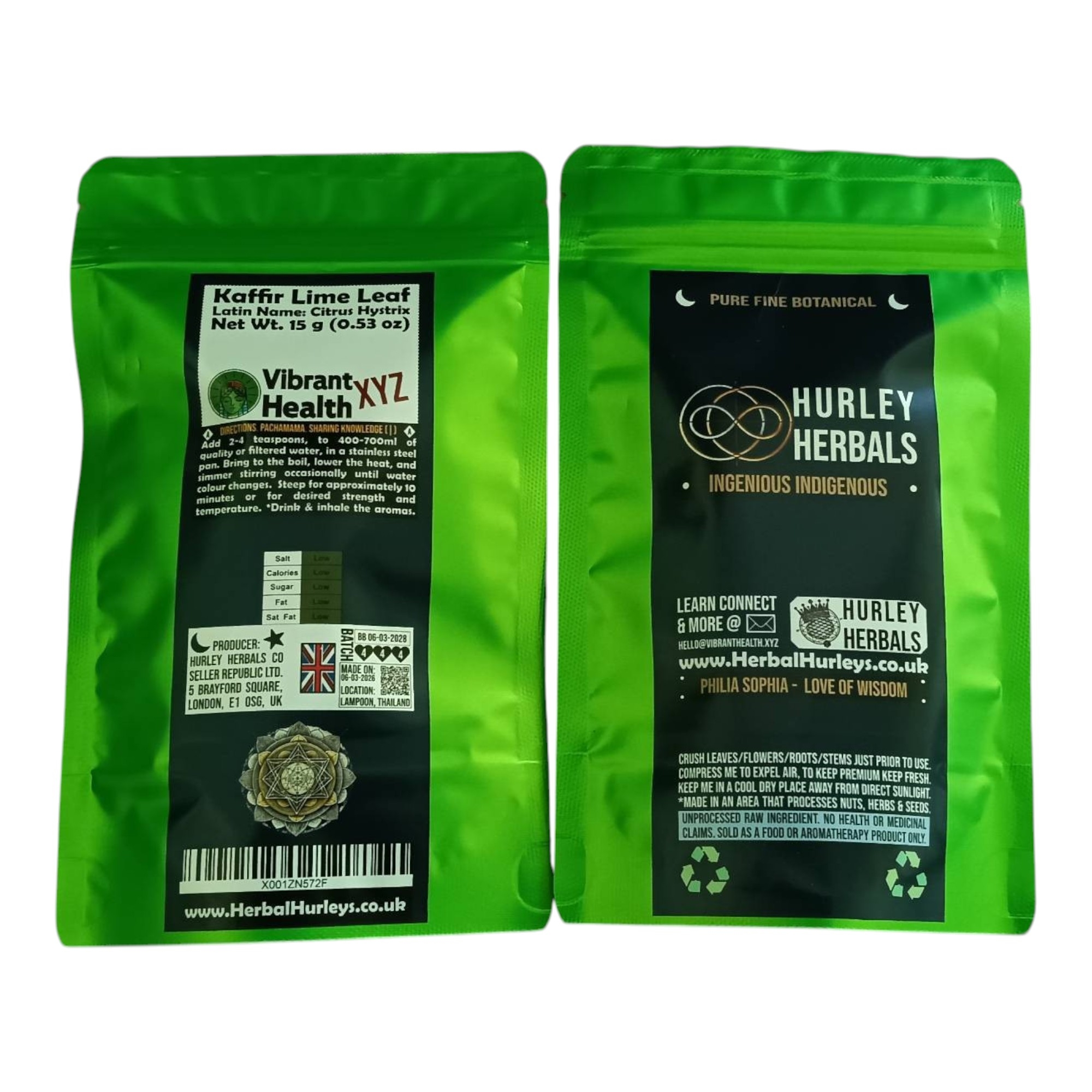
Tea House method, as supplied: add 1–2 tablespoons of leaves to 1 litre of water in a stainless steel pan. Bring to a boil and simmer for 5–10 minutes according to taste. The colour deepens as it steeps. The herbs may be reused 2–4 times over the following 2 days, with flavour varying between brews.
Single cup: 2 to 3 torn leaves per 250ml, water off the boil, 5 to 8 minutes. Sharper than most herbal infusions. It takes honey well and it is very good iced with a slice of ginger.
It depends entirely on what you are doing, and getting this wrong is the usual reason a dish ends up with chewy green shards in it.
| Preparation | What to do with the leaf | Eaten or removed? |
|---|---|---|
| Soups and broths | Tear either side of the central vein, leave whole | Removed |
| Curries | Tear, add with the coconut milk | Removed, or eaten around |
| Curry paste | Rehydrate, strip out the vein, pound | Eaten, fully broken down |
| Stir-fry and salad | Rehydrate, strip the vein, slice to a thread | Eaten |
| Tea | Tear, steep | Removed |
The central vein is the thing to watch. It stays tough however long you cook it, so anywhere the leaf is meant to be eaten, the vein comes out first. Anywhere the leaf is an aromatic that gets lifted out, leave it in.
Because the oil is inside the leaf, not on it. Citronellal sits in glands within the leaf tissue, and an intact leaf dropped into a pot presents nothing but a waxy cuticle to the water. Very little comes out.
Fold the leaf and tear down either side of the vein and you open the tissue along the break. The difference is not subtle — the same number of leaves will give you two noticeably different broths depending on whether you tore them.
The same logic explains why a dry rub works. Blitzing the dry leaf shatters every oil gland at once, which is the most complete extraction available short of distillation.
Ingredients: Makrut lime leaves (Citrus hystrix). Single ingredient. Nothing added.
Allergens: This product contains none of the 14 allergens that must be declared under UK law — celery, cereals containing gluten, crustaceans, eggs, fish, lupin, milk, molluscs, mustard, peanuts, sesame, soybeans, sulphur dioxide and sulphites, and tree nuts.
We publish this before you buy because we have to. Under Article 14 of assimilated Regulation (EU) 1169/2011, food sold at a distance must carry the same mandatory information as food bought in a shop, available free of charge before the purchase is concluded and again at delivery.
Nutrition declaration: Not required for this product. Annex V of assimilated Regulation (EU) 1169/2011 exempts herbs and spices, and all forms of tea and herbal infusions containing no added ingredients that would change nutritional value. Makrut lime leaf qualifies on both counts.
We value the rich heritage of herbal traditions that spans centuries. Our interest in herbs is informed by both historical practices and modern understanding of botanicals.
We source our ingredients from carefully selected suppliers who follow sustainable harvesting and cultivation practices. Our production methods are designed to preserve the natural qualities of our herbs through vacuum sealing and gentle processing techniques that maintain freshness and flavour integrity.
Our packaging is designed to be reused. Simply wash thoroughly after use.
Herb stocks are rotated annually to ensure freshness. Please note packaging may vary as we update our product range.
Store in a cool, dry place away from direct sunlight. Best before: see base of package. Kept airtight and dark they hold for months. The test is the same as any aromatic leaf — tear one, and if there is no citrus on the break, the oils have gone.
How many dried leaves replace fresh?
Roughly two dried per one fresh. Dried retains an estimated 40 to 50% of the aroma, so a recipe calling for 4 to 6 fresh wants 8 to 12 dried.
Why is it called kaffir lime?
It is the name most UK customers know it by. Kaffir is a racial slur in South Africa, and makrut lime, from the Thai, is now widely preferred. Same plant either way.
Why does the leaf have two lobes?
The lower lobe is a winged petiole — the leaf stalk flattened and gone green. The upper lobe is the leaf blade. Both are aromatic, and one double leaf counts as one leaf in a recipe.
Should I tear the leaves before cooking?
Yes. Fold and tear down either side of the central vein. Intact leaves give up very little; torn, they release along the break.
Can I eat the leaves?
Only when sliced to a thread. Whole or torn leaves are aromatics — lift them out before serving, like a bay leaf.
Can I use them for tea?
Yes. Two to three torn leaves per 250ml, off the boil, 5 to 8 minutes. Sharp, floral, very good iced.
Do they contain allergens?
No. None of the 14 allergens that must be declared under UK law. Single ingredient, nothing added.
How long do they keep?
Each pack carries a best before date on the base, alongside the batch ID and picked date. Store cool, dry and out of direct sunlight.
Last updated: 8 September 2026.
Botanical data cross-checked against Missouri Botanical Garden and published essential oil analyses. Culinary quantities reflect cross-source consensus in Thai cookery references.
Raw ingredient. Packaging may vary. All herbs are marked with Batch ID, Picked Date and Best Before Date. No health claims made. Information on this website is for educational purposes only and is not intended as medical advice.
| Weight | 15 g |
|---|---|
| Dimensions | 12 × 2.5 × 14.8 cm |
| Colour | n/a |
| Herbal Extraction | n/a |
| Country of origin | Thailand |
| Ean | 731199451761 |
| Flavour | Kaffir Lime Leaf |
| Indigenous herbal use | Good Health |
| Indigenous stone use | n/a |
| Ingredients | Dried Kaffir Lime Leaves (Citrus Hystrix) |
| Metal | n/a |
| Semi precious stone | n/a |
| Tribe | n/a |
| Wild essential oil | n/a |
| Weight |
Only logged in customers who have purchased this product may leave a review.




There are no reviews yet.