RAW INGREDIENT
🛒 Buy 4 Save 20% – Mix & Match
Average UK Delivery Time: 1-3 Days
✈️ Free UK Delivery – Orders Over 25 GBP
📦 9.95 GBP Next Day Delivery (Orders before 12 noon)

Original price was: £9.99.£5.99Current price is: £5.99.
RAW INGREDIENT
🛒 Buy 4 Save 20% – Mix & Match
Average UK Delivery Time: 1-3 Days
✈️ Free UK Delivery – Orders Over 25 GBP
📦 9.95 GBP Next Day Delivery (Orders before 12 noon)
77 in stock
Raspberry leaf is the dried leaf of Rubus idaeus, the same plant that grows the fruit. It brews a mild, faintly tannic infusion that tastes closer to black tea than to fruit — nothing like the berry, which surprises most people the first time.
Air-dried, 100% stalk free, chopped, ground, sieved and triple filtered. One of the few plants in this range that grows wild across Britain, in hedgerows and woodland clearings.
A deciduous, thicket-forming shrub in the Rosaceae family — the rose family, alongside apples, pears, plums and almonds. It grows to 1 to 2 metres, with prickly cane-like stems rising from a perennial root system, spreading by suckers and underground stolons into dense colonies.
Leaves are alternate and pinnately compound, with a doubly serrated margin and a noticeably paler, near-silver underside. Crush one and it smells green and faintly astringent rather than of fruit.
Because they come from two different kinds of cane, and this is the detail most people never notice.
Raspberry roots are perennial but the canes are biennial — each cane lives two growing seasons and then dies. A first-year cane, called a primocane, carries leaves only, usually with five leaflets. In its second year the same cane becomes a floricane, produces flowers and fruit, and its leaves carry three leaflets.
So a handful of raspberry leaf holds both: five-leaflet leaves from canes that were only growing, and three-leaflet leaves from canes that were fruiting. Same plant, same season, different job.
Native across Europe, northern Asia and Japan, with a closely related variety native across North America. It is hardy through USDA zones 4 to 8 — a genuinely cold-climate plant, and the odd one out in a range dominated by the tropics.
In the wild it colonises open and disturbed ground: woodland clearings, cut-overs, burns, roadsides and rights of way. It moves into gaps fast and holds them. In the south of its range it retreats to high altitude, because it wants a cold winter.
It points at a mountain. The species name refers to Mount Ida near Troy, in what is now northwest Turkey, where the ancient Greeks knew the plant. Rubus is simply the Latin for bramble.
The fruit is worth a note too, since it is not botanically a berry. A raspberry is an aggregate fruit — a cluster of small drupelets, each one a miniature stone fruit, arranged around a conical receptacle. The receptacle stays on the plant when you pick it, which is why a raspberry is hollow and a blackberry is not.
| Botanical name | Rubus idaeus |
| Family | Rosaceae (rose family) |
| Part used | Leaf, 100% stalk free |
| Processing | Air dried, chopped, ground, sieved, triple filtered |
| Net weight | 15g |
| Yield | 12–15 cups, herbs reusable 2–4 times |
| Aroma | Subtle, herbal, earthy — not fruity |
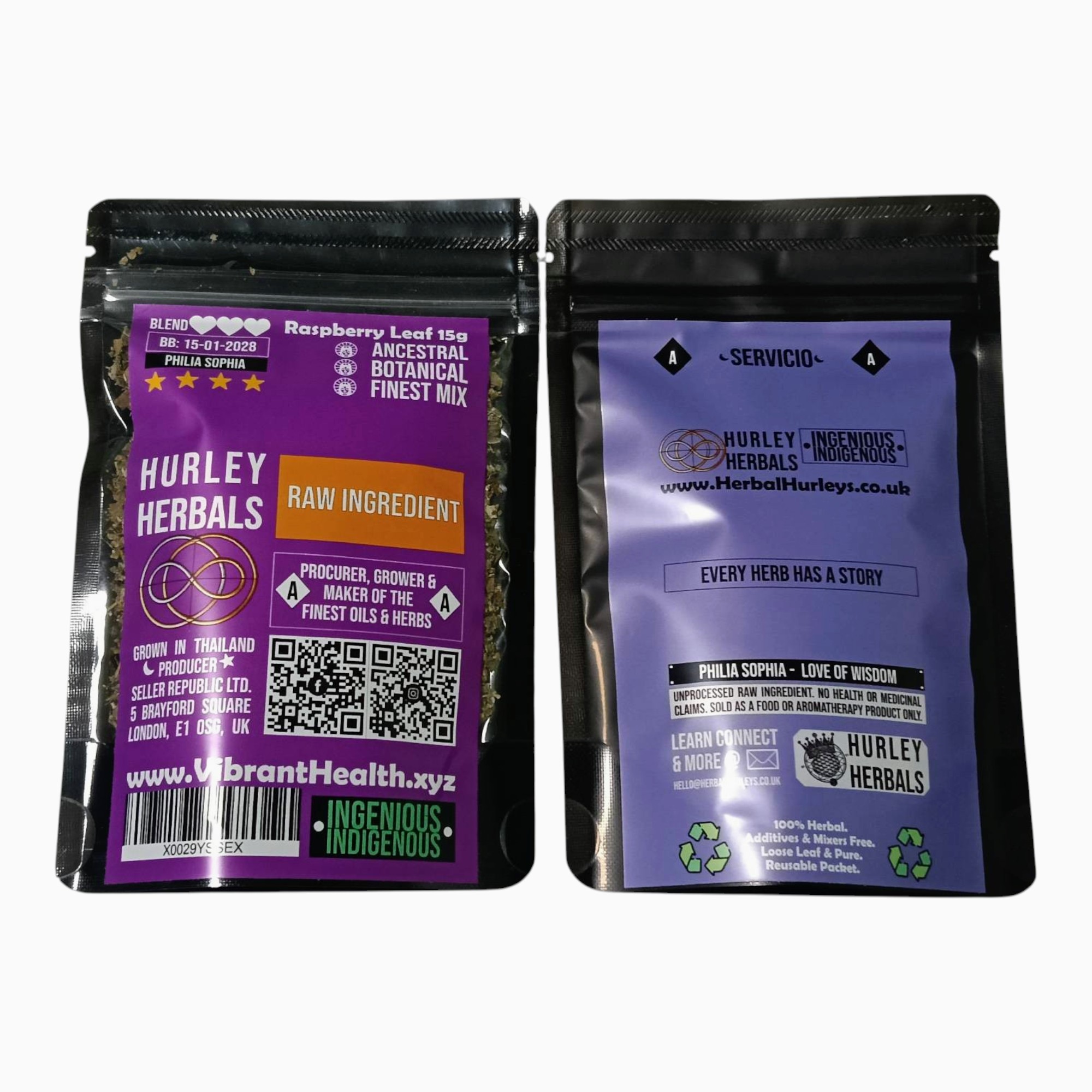
| Ingredients | Pure loose leaf herbal tea. Raspberry leaf only. |
| On pack | Batch ID, picked date, best before date |
| Packed by | Seller Republic Limited (Vibrant Health XYZ), UK — general food business product or raw material |
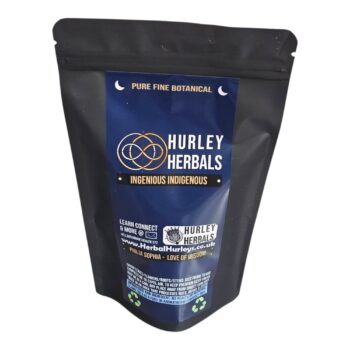
| Packaging | Vacuum sealed, reusable |
Tea House method, as supplied: add 1–2 tablespoons of herbs to 1 litre of water in a stainless steel pan. Bring to a boil and simmer for 5–10 minutes according to taste preference. The colour will deepen as it steeps. The herbs may be reused 2–4 times over the following 2 days, with flavour varying between brews.
1 heaped teaspoon per 250ml, water straight off the boil, 5 minutes for a light cup and 8 to 10 for a fuller one. It brews a clear amber and holds a light tannic grip — closer in character to a weak black tea than to a fruit infusion.
No, and this is the single most common surprise. The fruit flavour lives in the fruit. The leaf is green, mildly astringent and slightly earthy. If you want raspberry flavour in the cup, add dried fruit — the leaf will not do it.
2 teaspoons in 500ml of cold water, refrigerated overnight, then strained. Cold brewing pulls less tannin, so it comes out softer and rounder. Keeps three days refrigerated.
Shorten the steep. Raspberry leaf is tannic and, unlike lemongrass, it will turn drying and bitter if pushed too long. Five minutes is plenty to start with.
This is the single most common mix-up, and the two products have almost nothing in common beyond the plant.
| Raspberry leaf (this) | Raspberry fruit tea | |
|---|---|---|
| Part of the plant | Leaf, from the cane | Fruit, or usually flavouring |
| Colour in the cup | Clear amber | Pink to red |
| Flavour | Green, mildly astringent, earthy | Sweet, fruity, often perfumed |
| Tannin | Present — gives structure | Little to none |
| Closest comparison | Weak black tea | Squash or cordial |
| Typical contents | One ingredient | Frequently hibiscus, apple and flavouring |
If you want the cup to taste of raspberries, this is not the product — add dried fruit to it, or buy fruit tea. If you want a mild, single-ingredient leaf infusion with some backbone, this is exactly it.
Raspberry is the one plant in this range that grows wild across Britain. It colonises open and disturbed ground — woodland clearings, old cut-overs, burns, railway embankments and roadsides — spreading by suckers and stolons into dense thickets that hold their territory.
That matters for two reasons. It is a familiar plant rather than an imported curiosity, so most people can picture it. And it is a cold-climate species in a catalogue dominated by the tropics, hardy through USDA zones 4 to 8, which is why in the south of its range it retreats up mountains to find a proper winter.
Its mildness is the point — it makes a good base that lets something else lead.
They are close relatives — both are Rubus, both grow in the same hedgerows, and both leaves have been brewed for centuries. Two details separate them.
The underside. Raspberry leaves are noticeably pale, almost silver-white beneath, against a green upper surface. Blackberry leaves are green on both sides.
The fruit. This is the definitive test if you are picking your own. A raspberry comes away hollow, because the conical receptacle stays behind on the plant. A blackberry keeps its receptacle inside, which is why it is solid in the middle and heavier in the hand.
In the cup, blackberry leaf brews darker and more tannic. Raspberry leaf is the milder of the two.
Three methods of spread at once. The plant sends up suckers from its perennial root system, runs stolons across the surface, and pushes rhizomes below it. Any one of those would make it vigorous. Together they turn a single plant into a thicket.
That is why it is a coloniser of disturbed ground — woodland clearings, burns, old cut-overs, roadsides and railway embankments. It arrives in a gap, occupies it, and holds it against slower plants.
It also explains the harvest. Because the root system is perennial and only the canes are biennial, cutting leaf does not damage the plant. A stand yields year after year without replanting, which is the same standing-crop logic that makes lemongrass practical for smallholders.
Ingredients: Raspberry leaf (Rubus idaeus). Single ingredient. Nothing added.
Allergens: This product contains none of the 14 allergens that must be declared under UK law — celery, cereals containing gluten, crustaceans, eggs, fish, lupin, milk, molluscs, mustard, peanuts, sesame, soybeans, sulphur dioxide and sulphites, and tree nuts.
We publish this before you buy because we have to. Under Article 14 of assimilated Regulation (EU) 1169/2011, food sold at a distance must carry the same mandatory information as food bought in a shop, available free of charge before the purchase is concluded and again at delivery.
Nutrition declaration: Not required for this product. Annex V of assimilated Regulation (EU) 1169/2011 exempts all forms of tea and herbal infusions containing no added ingredients that would change nutritional value.
We value the rich heritage of herbal traditions that spans centuries. Our interest in herbs is informed by both historical practices and modern understanding of botanicals.
We source our ingredients from carefully selected suppliers who follow sustainable harvesting and cultivation practices. Our production methods are designed to preserve the natural qualities of our herbs through vacuum sealing and gentle processing techniques that maintain freshness and flavour integrity.
Our packaging is designed to be reused. Simply wash thoroughly after use.
Herb stocks are rotated annually to ensure freshness. Please note packaging may vary as we update our product range.
Store in a cool, dry place away from direct sunlight. Best before: see base of package. Dried leaf holds well in an airtight jar. Raspberry leaf fades quietly rather than dramatically — if the brew has gone from amber to pale straw, the leaf is past its best.
Does raspberry leaf tea taste of raspberries?
No. The fruit flavour is in the fruit. The leaf brews mild, green and lightly tannic — closer to a weak black tea. Add dried fruit if you want the berry.
Why do some leaves have five leaflets and some three?
They come from different canes. First-year canes, called primocanes, bear leaves with usually five leaflets. Second-year canes, floricanes, flower and fruit and bear leaves with three.
Where does the name idaeus come from?
Mount Ida near Troy, in what is now northwest Turkey, where the ancient Greeks knew the plant.
Is a raspberry a berry?
Botanically no. It is an aggregate fruit made of many small drupelets. The conical receptacle stays on the plant, which is why a raspberry is hollow.
How long should I steep it?
Five minutes for a light cup, eight to ten for a fuller one. Longer than that and the tannin turns it drying.
Can I use it in kombucha?
It is one of the few herbal leaves tannic enough to work as a partial substitute for tea. Blend it rather than replacing tea entirely.
Does it contain allergens?
No. None of the 14 allergens that must be declared under UK law. Single ingredient, nothing added.
How long does it keep?
Each pack carries a best before date on the base, alongside the batch ID and picked date. Store cool, dry and out of direct sunlight.
Last updated: 8 September 2026.
Botanical data cross-checked against Missouri Botanical Garden, Northern Ontario Plant Database and iNaturalist.
Raw ingredient. Packaging may vary. All herbs are marked with Batch ID, Picked Date and Best Before Date. No health claims made. Information on this website is for educational purposes only and is not intended as medical advice.
| Weight | 15 g |
|---|---|
| Dimensions | 10 × 18 × 2 cm |
| Colour | n/a |
| Herbal Extraction | n/a |
| Country of origin | Thailand |
| Ean | 680699850928 |
| Flavour | Blend Skullcap |
| Indigenous herbal use | Good Health |
| Indigenous stone use | n/a |
| Ingredients | n/a |
| Metal | n/a |
| Semi precious stone | n/a |
| Tribe | n/a |
| Wild essential oil | n/a |
| Weight |
Only logged in customers who have purchased this product may leave a review.


There are no reviews yet.