RAW INGREDIENT
🛒 Buy 4 Save 20% – Mix & Match
Average UK Delivery Time: 1-3 Days
✈️ Free UK Delivery – Orders Over 25 GBP
📦 9.95 GBP Next Day Delivery (Orders before 12 noon)







Original price was: £9.99.£5.99Current price is: £5.99.
RAW INGREDIENT
🛒 Buy 4 Save 20% – Mix & Match
Average UK Delivery Time: 1-3 Days
✈️ Free UK Delivery – Orders Over 25 GBP
📦 9.95 GBP Next Day Delivery (Orders before 12 noon)
32 in stock
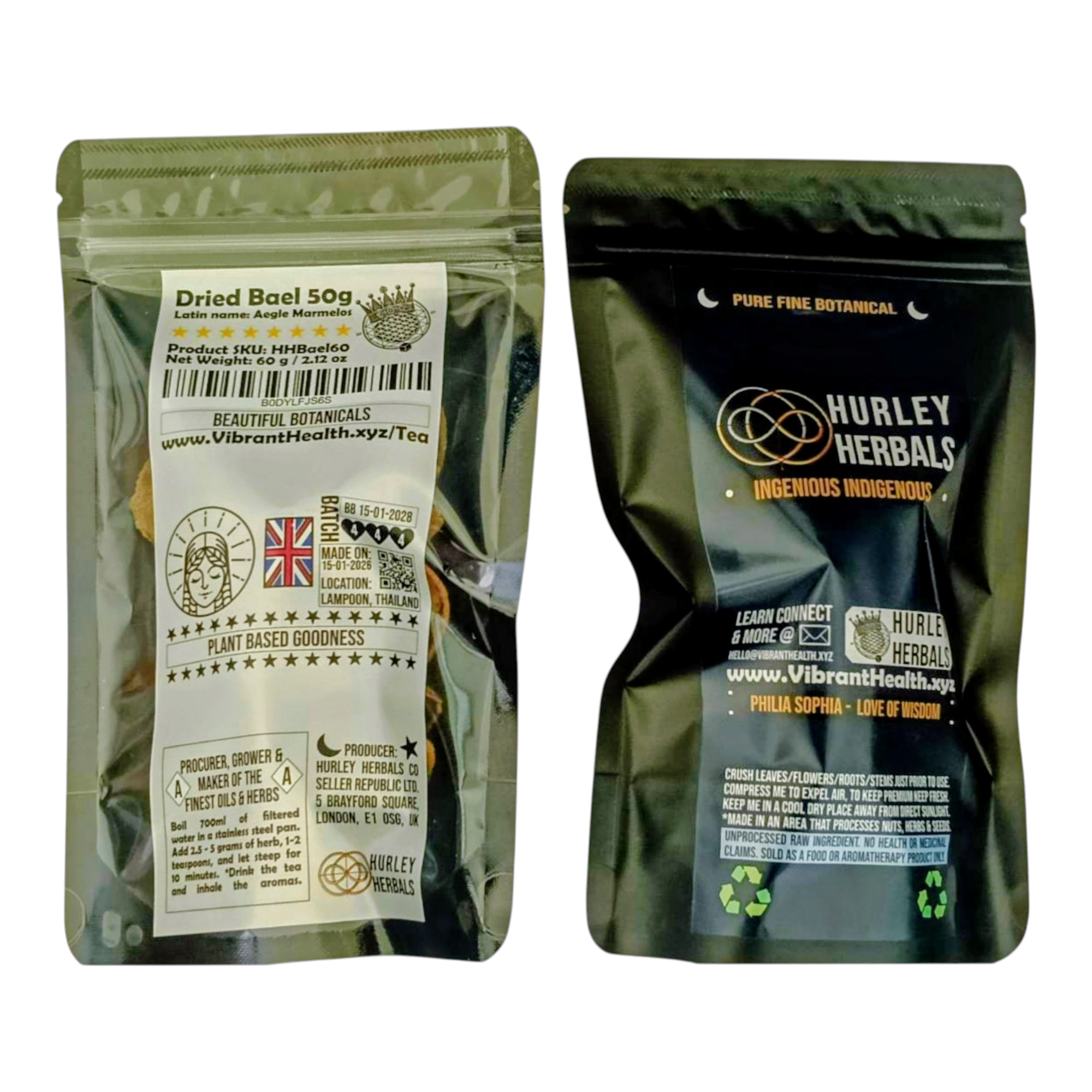
Bael is the sun-dried sliced fruit of Aegle marmelos, a member of the citrus family that grows a fruit inside a shell hard enough to need a hammer. Cut into rounds and dried, it simmers into a deep amber drink that is sweet, resinous and faintly like caramelised apple — the drink Thai monks know as matoom.
Nothing else in this range tastes like it, and nothing else is prepared quite like it either. Bael needs simmering, not steeping.
A deciduous tree in the Rutaceae family — the citrus family. Bael is a distant relative of every orange, lemon and lime you have eaten, and of the kumquat and the white sapote, though you would never guess it from the fruit.
The tree reaches 6 to 15 metres, with fiercely spiny branches carrying single or paired spines 1 to 2cm long. Its leaves are trifoliate — three leaflets to a leaf, shaped like a trident, which is precisely why the tree is sacred to Shiva and why bael leaves are offered in temples across India.
A subglobose berry, 5 to 12.5cm across, with a shell so hard it has to be cracked rather than cut. Inside, 8 to 16 segments of sticky, aromatic, orange-tinged pulp hold 6 to 10 seeds, each seed wrapped in a mucilage that sets solid as it dries.
The rind carries up to 20% tannin. The aroma survives processing remarkably well, which is unusual for a dried fruit and is the reason dried bael makes a better drink than most dried fruits do.
Native to the Indian subcontinent — studies point to the Eastern Ghats and the central to northern parts of India — and naturalised across Southeast Asia. It grows wild in dry, open forest in India, Sri Lanka, Pakistan and Bangladesh, from sea level to around 1,200 metres, on annual rainfall anywhere between 570 and 2,000mm.
It is exceptionally hardy. Bael tolerates temperature extremes and poor, acidic or alkaline soils that would kill most fruit trees, which is why it is grown on marginal land where nothing more demanding will grow.
Two reasons, one in India and one in Thailand.
In India the trifoliate leaf is read as the trident of Shiva, and bael trees are a fixture of Hindu temple gardens. The leaves are offered rather than eaten.
In Thailand, where this fruit comes from, bael is called matoom and is commonly planted at Buddhist temples — and there the dried sliced fruit is boiled with water to make a drink long associated with monks. That is the preparation on this page.
| Botanical name | Aegle marmelos |
| Also known as | Bael, matoom, wood apple, Bengal quince, stone apple |
| Family | Rutaceae (citrus family) |
| Part used | Fruit, sliced |
| Origin | Thailand |
| Cultivation | Small local farms, traditional methods |
| Processing | Sliced, then naturally sun-dried |
| Net weight | 50g |
| Aroma | Sweet, resinous, caramelised, faintly citrus |
| Form | Dried slices |
| Ingredients | 100% bael fruit. No additives. |
| On pack | Batch ID, picked date, best before date |
| Packed by | Seller Republic Limited (Vibrant Health XYZ), UK — general food business product or raw material |
| Packaging | Vacuum sealed, reusable |
Bael is simmered, not steeped. This is the single most important thing on the page. A dried slice is dense and woody in a way a leaf is not, and pouring hot water over it gives you faintly flavoured water. It needs sustained heat to open up.
Tea House method, as supplied: add 1–2 tablespoons to 1 litre of water in a stainless steel pan. Bring to a boil and simmer for 5–10 minutes according to taste preference. The colour will deepen as it steeps. The pieces may be reused 2–4 times over the following 2 days, with flavour varying between brews.
1 to 2 teaspoons per 250ml. Bring to a simmer and hold it there 10 to 15 minutes, then strain. It brews a clear deep amber and needs no sweetening, though it takes honey well.
Longer and slower. A generous handful in a litre of water, brought to a boil and then simmered 20 to 30 minutes until the liquid is dark and syrupy, then strained and often served over ice. This is the version worth making if you want to understand what the fruit actually tastes like.
Bael slices hold up to repeated simmering better than leaves hold up to steeping. Two to four rounds over a couple of days is normal, each lighter than the last.
Because a whole bael fruit is not something you could pack at 50g. The fruit is a subglobose berry 5 to 12.5cm across with a hard woody shell — a single one weighs several hundred grams, and it has to be cracked open rather than cut.
Slicing is the standard preparation across Thailand for exactly that reason. The fruit is opened, cut into rounds and laid out to dry in the sun, which does three things at once: it exposes the sticky pulp so it dries through rather than fermenting, it makes the material portionable, and it gives you pieces with cut faces that give up their sugars in a pot.
A slice is also why the simmering works. Cut faces present the pulp directly to the water; an intact fruit would present nothing but shell.
Sweet without sugar. The dominant notes are caramel and dried apple, with a resinous, slightly medicinal edge underneath and a faint citrus lift that gives away the family it belongs to.
It is one of the few infusions people describe as tasting cooked rather than green. If you like rooibos, roasted barley tea or dried longan, bael sits in that territory.
This is the difference between a good cup of bael and a disappointing one, so it is worth setting out plainly.
| Steeping (wrong for bael) | Simmering (right) | |
|---|---|---|
| Method | Pour hot water over, wait | Bring to a simmer and hold |
| Time | 5 minutes | 10–15 minutes, or 20–30 Thai style |
| Result | Pale, faintly sweet water | Deep amber, full caramel body |
| Why | Dried fruit is dense and slow to give up sugars | Sustained heat breaks it down |
| Works for | Leaves and flowers | Fruits, roots, barks |
The rule generalises: leaves and flowers steep, fruits and roots simmer. A leaf is thin and gives up its oils in minutes. A piece of dried fruit is dense, sugary and woody, and hot water sitting on it barely penetrates. If you have ever found a fruit tea weak, this is usually why.
Most dried fruit loses its character. Bael does not, and the trade has remarked on it for a long time — the characteristic aroma is retained even after processing, which is unusual enough to be noted in the horticultural literature.
Part of the answer is the shell. Bael fruit sits inside a hard woody rind carrying up to 20% tannin, which protects the pulp while it ripens on the tree and while it dries afterwards. The pulp inside is sticky and sugar-dense rather than watery, so drying concentrates it instead of hollowing it out.
That is why dried bael makes a serious drink where dried apple or dried mango would give you something thin and sweet.
Ingredients: Bael fruit (Aegle marmelos). Single ingredient. Nothing added.
Allergens: This product contains none of the 14 allergens that must be declared under UK law — celery, cereals containing gluten, crustaceans, eggs, fish, lupin, milk, molluscs, mustard, peanuts, sesame, soybeans, sulphur dioxide and sulphites, and tree nuts.
We publish this before you buy because we have to. Under Article 14 of assimilated Regulation (EU) 1169/2011, food sold at a distance must carry the same mandatory information as food bought in a shop, available free of charge before the purchase is concluded and again at delivery.
Nutrition declaration: Not required for this product. Annex V of assimilated Regulation (EU) 1169/2011 exempts all forms of tea and herbal or fruit infusions containing no added ingredients that would change nutritional value, and unprocessed single-ingredient products.
We value the rich heritage of herbal traditions that spans centuries. Our interest in herbs is informed by both historical practices and modern understanding of botanicals.
We source our ingredients from carefully selected suppliers who follow sustainable harvesting and cultivation practices. Our production methods are designed to preserve the natural qualities of our herbs through vacuum sealing and gentle processing techniques that maintain freshness and flavour integrity.
Our packaging is designed to be reused. Simply wash thoroughly after use.
Herb stocks are rotated annually to ensure freshness. Please note packaging may vary as we update our product range.
Store in a cool, dry place away from direct sunlight. Best before: see base of package. Dried bael slices are sturdier than a dried leaf and keeps its aroma unusually well through storage. Keep it airtight anyway — the fruit still carries some residual sugar and will soften if it takes on moisture.
Do you steep bael or simmer it?
Simmer. This is the key difference from a leaf tea. Dried fruit is dense and needs sustained heat — 10 to 15 minutes at a simmer, or 20 to 30 for the traditional Thai method. Pouring hot water over it and waiting will not work.
What does bael taste like?
Sweet without sugar — caramel and dried apple, with a resinous edge and a faint citrus lift. Closer to rooibos or roasted barley tea than to anything green.
What is matoom?
The Thai name for bael. In Thailand the tree is commonly planted at Buddhist temples and the dried sliced fruit is boiled into a drink long associated with monks.
Is bael related to citrus?
Yes. Aegle marmelos is in the Rutaceae family, the citrus family, and is a distant relative of oranges, lemons, limes and kumquats.
Why is the bael tree sacred?
Its leaves are trifoliate — three leaflets shaped like a trident — which is read as the trident of Shiva. Bael trees are a fixture of Hindu temple gardens and the leaves are offered rather than eaten.
How many times can I reuse it?
Two to four rounds over a couple of days, each lighter than the last. Bael holds up to repeated simmering better than leaves hold up to repeated steeping.
Does it need sweetening?
Not usually. It brews sweet on its own. Honey works if you want more, and a pinch of salt is traditional in the Indian sherbet version.
Does it contain allergens?
No. None of the 14 allergens that must be declared under UK law. Single ingredient, nothing added.
Last updated: 8 September 2026.
Botanical data cross-checked against the PROSEA Foundation, Britannica, India Biodiversity Portal and published horticultural records.
Raw ingredient. Packaging may vary. All herbs are marked with Batch ID, Picked Date and Best Before Date. No health claims made. Information on this website is for educational purposes only and is not intended as medical advice.
| Weight | 50 g |
|---|---|
| Dimensions | 15 × 2.5 × 22 cm |
| Colour | n/a |
| Herbal Extraction | n/a |
| Country of origin | Thailand |
| Ean | B0DYLFJS6S |
| Flavour | Aluminium Ziplock |
| Indigenous herbal use | Good Health |
| Indigenous stone use | n/a |
| Ingredients | Dried Bael Fruit (Aegle Marmelos) |
| Metal | n/a |
| Semi precious stone | n/a |
| Tribe | n/a |
| Wild essential oil | n/a |
| Weight |
Only logged in customers who have purchased this product may leave a review.




There are no reviews yet.